
Custom corporate learning software development delivers exactly what off-the-shelf platforms cannot: training programs built around your organization’s unique workflows, compliance requirements, and business goals. Rather than adapting your processes to fit generic tools, you create a learning management system that adapts to you—integrating seamlessly with existing systems while scaling alongside your growth.
This comprehensive guide explores everything organizations seeking custom learning solutions need to know, from essential features and technology considerations to development process and partner selection.
What is Corporate Learning Software Development?
Corporate learning software development is the end-to-end process of designing, building, deploying, and maintaining custom digital platforms that support employee training, partner education, and customer enablement within a business context. Unlike purchasing a commercial learning management system, custom development creates solutions tailored to your specific workflows, branding, data requirements, and compliance needs.
The distinction between custom development versus off-the-shelf LMS solutions centers on control and fit. Commercial platforms offer quick deployment and lower upfront costs, but they often include feature bloat—you pay for capabilities you’ll never use while lacking functionality essential to your operations. Custom solutions eliminate this mismatch by building precisely what your organization requires. With custom development, curated content can be integrated to deliver comprehensive, personalized learning journeys that strategically align with both organizational and individual goals.
Corporate learning platforms come in several forms:
– Learning Management Systems (LMS): Focus on course delivery, enrollment, progress tracking, assessments, and certification management
– Learning Experience Platforms (LXP): Emphasize learner experience, content discovery, personalized learning paths, and social learning features
– Microlearning applications: Deliver training in short, focused modules optimized for mobile devices
– Skills tracking systems: Map competencies to roles, identify skill gaps, and connect with performance data
Custom solutions address specific business requirements that generic platforms cannot accommodate. Whether you need deep integration with your HRIS, unique assessment workflows, or industry-specific compliance tracking, custom software engineering delivers functionality aligned with how your organization actually operates rather than how a vendor assumes you should. A custom platform is a scalable solution, designed to adapt seamlessly as your organization grows and user numbers increase, ensuring workflows remain uninterrupted.

Benefits of Custom Corporate Learning Software Development
Organizations invest in custom development when standard solutions create friction rather than efficiency. The benefits extend beyond feature lists to strategic advantages that impact business outcomes over years of use.
A key advantage is the ability to build a scalable solution. A scalable solution can adapt to any number of users you need, maintaining ease of use and ensuring workflows are not disrupted as your organization grows. Scalability also enables organizations to deliver uniform training across departments, regions, and languages, supporting consistent learning experiences as the business expands.
Complete Control Over Features and Functionality
Building custom corporate training software means constructing exactly what your organization needs without paying for unused modules or wrestling with workarounds. Commercial platforms typically see only 20% of features actively used—yet organizations pay for 100%.
Custom development focuses resources on essential capabilities:
– Create unique learning experiences reflecting company culture and established processes
– Implement assessment methods that match your competency frameworks
– Design workflows that trigger training based on HR events like role changes or certifications nearing expiration
– Build branching learning paths that adapt to individual learner needs
Integration represents a particular strength of custom solutions. Rather than relying on generic connectors, you create seamless integrations between your corporate learning management system and business-critical platforms. Your HRIS provisions users automatically. Your CRM triggers partner enablement courses when new relationships form. Your performance management system pulls completion data directly.
For example, a custom skills tracking system can integrate directly with performance reviews, surfacing skill gaps identified through learning assessments within manager dashboards during review cycles.
Enhanced Security and Compliance
Regulated industries face requirements that generic platforms struggle to address. Healthcare organizations must maintain HIPAA compliance, often relying on specialized HIPAA compliance software solutions. Financial services companies navigate complex regulatory frameworks. Manufacturing operations track safety compliance training with detailed audit trails.
Custom corporate learning software development implements security controls designed for your specific requirements:
– Encryption at rest and in transit using industry-appropriate standards
– Role-based access control matching your organizational structure
– Audit logging capturing exactly what compliance auditors need
– Data storage within required jurisdictions for GDPR or regional data sovereignty rules
– Custom certification tracking with automated expiration alerts and renewal workflows
Rather than hoping a commercial platform’s generic compliance features satisfy auditors, you build mandatory training tracking precisely aligned with regulatory expectations.
Scalability and Long-term Cost Efficiency
Commercial LMS platforms typically charge per-user fees that compound as organizations grow. What seems affordable at 500 employees becomes prohibitive at 5,000. Custom solutions flip this equation: higher initial investment but dramatically lower marginal costs per additional user.
According to industry research, organizations using corporate LMS solutions can reduce training costs by up to 60% compared to in person training approaches, eliminating travel, printing, and instructor expenses.
The financial analysis often favors custom development for mid sized organizations and enterprises:
| Factor | Commercial LMS | Custom Solution |
| Year 1 Cost |
|
|
| Year 3 Cost |
|
|
| Year 5 Cost |
|
|
| Vendor Dependency |
|
|
Superior User Experience and Adoption
Even powerful systems fail when employees don’t use them. Custom development creates intuitive interfaces designed specifically for your learners rather than generic screens attempting to serve every possible organization. Engagement features align with your company culture rather than vendor assumptions:
– Gamification elements reflecting your organizational values and employee motivations
– Mobile-first design ensuring new hires and field workers access training naturally
– Social learning features connecting employees discover and share knowledge with colleagues
– Integration with daily workflows through Slack, Teams, or email to boost engagement
Custom dashboards serve different roles appropriately. Learners see their personalized learning paths and progress. Managers track team completion and identify development opportunities. Administrators access advanced reporting capabilities without overwhelming frontline users. When systems fit naturally into how people work, adoption follows. When they create friction, workarounds emerge—and learning programs fail to deliver their intended business outcomes.
Key Features to Include in Corporate Learning Software Development
Feature selection balances essential capabilities that every corporate learning management system requires against advanced functionality that differentiates your platform and drives strategic thinking around talent development. Incorporating curated content is crucial for supporting personalized and strategic learning journeys, enabling organizations to deliver tailored resources that align with both business objectives and individual learner needs.
Essential features include:
– User management: Role-based access, user groups, and permissions to control who can access what.
– Course creation and management: Tools for building, organizing, and updating training modules, including support for multimedia and interactive elements.
– Curated content: Ability to integrate and deliver curated content for comprehensive, personalized learning experiences that support targeted skill development.
– Progress tracking: Real-time dashboards for learners and administrators to monitor completion rates, scores, and engagement.
– Reporting and analytics dashboard: Visualize learner progress, identify trends, and measure training effectiveness. Data exports are available for building custom reports and conducting deeper analysis beyond built-in analytics features.
– Integrations: Seamless connections with HR systems, communication tools, and third-party content providers.
– Mobile compatibility: Responsive design or dedicated apps for learning on the go.
– Gamification: Badges, leaderboards, and rewards to boost engagement and motivation.
Core Learning Management Features
Every corporate training platform requires foundational capabilities:
Course creation and content management: Support multimedia content including video, audio, PDF, and interactive elements. Implement content versioning and organize learning resources through intuitive taxonomy. Standards compliance with SCORM, xAPI, and LTI ensures interoperability with external content. Support curated content to build comprehensive and personalized learning experiences tailored to organizational and individual goals.
User enrollment and progress tracking: Manage user accounts with appropriate roles and permissions across organizational hierarchies. Track course progress, module completion, and time spent learning. Enable self-enrollment, manager assignments, and automated workflows triggered by HR events.
Assessment tools: Include various question types—multiple choice, matching, fill-in-the-blank, scenario-based responses. Automated grading reduces administrative burden while manual review options support nuanced evaluations. Build question banks for randomized assessments.
Certification management: Track certifications with expiration dates and automated renewal reminders. Generate certificates automatically upon course completion. Integrate with external credentialing systems where applicable.
Reporting and analytics dashboard: Provide administrators with completion rates, assessment scores, drop-off analysis, and usage patterns. Enable reporting by department, location, role, or custom segments. Data exports allow for building custom reports and conducting deeper analytics beyond built-in dashboard capabilities.
Advanced Personalization and AI Capabilities
AI powered features increasingly differentiate effective learning platforms from basic content repositories:
– AI driven recommendations: Content suggestions based on role, skill gaps, learning history, and career aspirations help employees discover relevant courses without manual searching
– Adaptive learning paths: Personalized learning paths that adjust difficulty, pacing, and content based on individual progress and assessment performance
– Skills intelligence: Map competencies across the organization, identify skill gaps at individual and team levels, and connect learning to skills development
– Predictive analytics: Identify learners likely to disengage or fail before problems materialize, enabling proactive intervention
– Machine learning optimization: Analyze engagement patterns to optimize content delivery timing using spaced repetition principles
These AI features transform learning from passive content consumption into dynamic, responsive professional development experiences and are underpinned by robust machine learning development practices and architectures. Research indicates that 73% of organizations now use AI in L&D for personalized learning paths.
Social Learning and Collaboration Tools
Learning happens through interaction, not just content consumption. Social learning features, often delivered through dedicated social learning platforms that enable collaboration,create knowledge-sharing communities:
– Discussion forums where learners explore topics together and ask questions
– Peer-to-peer learning through mentorship matching and knowledge exchange
– Collaborative project spaces for team-based learning initiatives
– Employee-generated content enabling institutional knowledge capture
– Social proof elements including badges, leaderboards, and peer ratings
Integration with collaboration tools like Slack and Microsoft Teams embeds learning naturally into daily workflows. Push reminders, discussion notifications, and achievement celebrations reach employees where they already work.
Integration and API Capabilities
Standalone systems create data silos and manual processes. Robust integration capabilities connect your learning management system with the broader technology ecosystem and complement custom HR software development for core people processes:
| Integration Type | Purpose | Example Systems |
| HRIS Integration |
|
|
| CRM Integration |
|
|
| Authentication |
|
|
| Performance Management |
|
|
| Business Intelligence |
|
|
Corporate Learning Software Development Process
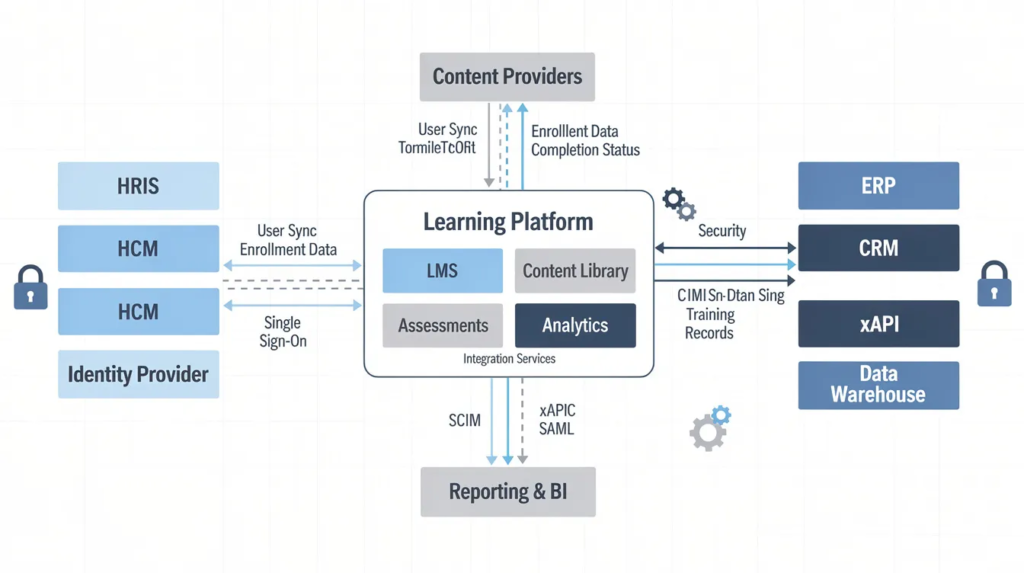
Building custom corporate learning software follows a structured methodology balancing thorough planning with agile adaptation based on feedback and learning.
Discovery and Requirements Analysis
Effective development begins with deep understanding of organizational needs, user expectations, and technical constraints. This phase typically spans 4-6 weeks and involves:
Stakeholder interviews: Engage L&D leaders, HR executives, compliance officers, IT teams, department managers, and representative learners. Each perspective reveals requirements that others miss.
User persona development: Create detailed profiles of different learner types—new hires during employee onboarding, experienced employees pursuing professional development, external partners accessing partner education programs, managers tracking team progress.
Journey mapping: Document current learning workflows and pain points. Identify opportunities where custom software eliminates friction or creates new capabilities.
Technical requirements gathering: Assess existing systems requiring integration, security requirements, hosting preferences, expected user volumes, and scalability needs. Evaluate data structures needed for analytics and reporting.
Feature prioritization: Use frameworks like MoSCoW (Must have, Should have, Could have, Won’t have) to prioritize capabilities. Balance immediate needs against future roadmap considerations.
Design and User Experience Planning
Design translates requirements into tangible interfaces and workflows:
Information architecture: Organize courses, learning paths, resources, and administrative functions into intuitive structures. Design navigation supporting different user roles and tasks.
Wireframing and prototyping: Create low-fidelity wireframes showing layout and functionality before investing in visual design. Build clickable prototypes for key user journeys to validate assumptions with stakeholders.
UI/UX design: Develop visual design consistent with company branding. Create responsive layouts functioning smoothly across desktop, tablet, and mobile devices. Design for engagement—clear progress indicators, celebration of achievements, intuitive interactions.
Accessibility planning: Ensure compliance with WCAG 2.1 AA standards. Address color contrast, font sizing, keyboard navigation, and screen reader compatibility. Accessibility benefits all users, not just those with disabilities.
Development and Testing Phases
Development follows agile methodologies with regular stakeholder involvement:
Sprint-based development: Two-week sprints deliver incremental functionality. Regular demonstrations gather feedback. Backlog refinement adjusts priorities based on learning.
Backend development: Build scalable cloud-native architecture using appropriate frameworks. Implement API layers connecting frontend experiences with data and business logic. Develop integrations with external systems.
Frontend development: Create responsive interfaces using modern JavaScript frameworks. Implement progressive web app capabilities for mobile accessibility. Build offline modes where field workers or factory floor access requires disconnected functionality.
Comprehensive testing: Unit tests verify individual components. Integration tests confirm systems work together. Performance testing validates behavior under load. Security testing identifies vulnerabilities. Usability testing with real users catches interface problems.
Deployment and Launch Strategy
Launching custom software requires careful planning beyond code completion:
Environment setup: Configure staging environments mirroring production for final testing and user training. Establish monitoring and alerting systems.
Data migration: Transfer content, user accounts, historical learning records, and compliance data from legacy systems. Validate data integrity before go-live.
Phased rollout: Begin with pilot groups to identify issues before broad deployment. Start with a single department or region to manage risk and gather feedback.
User training: Prepare administrators, content creators, managers, and learners for new systems. Provide documentation, quick reference guides, and helpdesk support.
Change management: Communicate value clearly. Set realistic expectations. Address concerns proactively. Monitor adoption and adjust approach based on user feedback.
Technology Stack Considerations for Corporate Learning Software
Technology choices impact performance, scalability, maintenance burden, and long-term costs. Understanding options helps organizations evaluate development partner recommendations.
Backend Technologies and Database Design
Modern corporate learning platforms leverage cloud infrastructure and proven frameworks:
Cloud platforms: AWS, Azure, and Google Cloud provide scalable infrastructure, managed services, and global availability. Choose based on existing organizational relationships, compliance requirements, and specific service needs.
Backend frameworks: Node.js with NestJS or Express offers JavaScript throughout the stack. Python with Django or FastAPI provides rapid development and data science integration. .NET Core serves organizations with Microsoft ecosystems. Java with Spring Boot handles complex enterprise requirements.
Database selection: Relational databases (PostgreSQL, MySQL) store structured data about users, courses, and enrollments reliably. Document databases (MongoDB) handle flexible content structures and analytics data. Search engines (Elasticsearch) power content discovery.
Architecture patterns: Microservices architecture separates concerns—assessment engines scale independently from content delivery. Message queues (RabbitMQ, Kafka) handle asynchronous operations like notifications and video processing. Caching layers (Redis) improve performance.
Frontend Development Approaches
User-facing interfaces require technologies balancing developer productivity with user experience:
– JavaScript frameworks: React, Angular, or Vue.js with TypeScript provide component-based architectures for complex interfaces
– Progressive Web Apps: PWA capabilities enable mobile accessibility, push notifications, and app-like experiences without app store distribution
– Content delivery networks: CDNs ensure fast loading globally, particularly important for video content
– Offline capability: Service workers and local caching enable learning even without connectivity—essential for manufacturing floors or field workers
Security and Compliance Implementation
Enterprise grade security requires deliberate implementation throughout the technology stack, often supported by dedicated SOC 2 compliance software for automated monitoring:
Authentication: OAuth 2.0 and SAML integration enables single sign-on with existing identity providers. Multi-factor authentication adds protection for sensitive operations.
Authorization: Role-based access control (RBAC) matches organizational hierarchies. Attribute-based access control (ABAC) enables finer-grained permissions where needed.
Data protection: TLS encrypts data in transit. Encryption at rest protects stored information. Key management follows security best practices.
Compliance documentation: Audit logging captures required events. Regular security audits identify vulnerabilities. Penetration testing validates defenses.

ROI and Business Impact Measurement
Demonstrating return on investment for corporate learning software development requires systematic measurement across multiple dimensions.
Organizations using custom LMS solutions report significant improvements: one project achieved 80% increase in course enrollments, 70% reduction in support queries, and 25% increase in customer renewals after launch.
Measuring business outcomes: Connect learning analytics with business metrics. Track time-to-productivity for new hires. Measure compliance incident reduction. Monitor productivity improvements in teams completing specific training programs. Link skills development to promotion rates and retention.
Key performance indicators to track:
| Metric Category | Specific Measures | Business Impact |
| Training Efficiency |
|
|
| Engagement |
|
|
| Compliance |
|
|
| Business Results |
|
|
Choosing the Right Development Partner
Partner selection significantly impacts project success. Evaluate potential partners across technical capabilities, process maturity, and industry understanding.
Technical Expertise and Experience
Look for partners demonstrating:
– Proven EdTech experience: Portfolio including learning management systems, corporate training platforms, or related educational technology
– Technical depth: Expertise in modern development frameworks, cloud platforms, and software architecture patterns
– Standards knowledge: Understanding of SCORM, xAPI, LTI, and accessibility standards like WCAG
– Integration capability: Experience connecting learning systems with HRIS, CRM, and enterprise platforms
Request case studies showing successful corporate learning projects with measurable outcomes.
Project Management and Communication
Effective partnerships require strong processes:
– Agile development methodology with regular stakeholder involvement
– Clear communication channels and project transparency
– Dedicated project management ensuring accountability
– Quality assurance processes catching issues before deployment
– Post-launch support and maintenance commitment
Evaluate how potential partners handled challenges on previous projects. The ability to navigate obstacles matters more than perfect initial estimates.
Industry Knowledge and Compliance Understanding
Domain expertise accelerates development and reduces risk; in highly regulated sectors this often includes access to specialized HIPAA compliance consulting services:
– Experience with industry-specific regulations (HIPAA, financial services compliance, safety standards)
– Understanding of corporate learning best practices and learner behavior patterns
– Knowledge of accessibility requirements and inclusive design principles
– Familiarity with enterprise security requirements and data protection standards
Partners who understand your industry ask better questions during discovery and make better recommendations throughout development.
Future Trends in Corporate Learning Software Development
Corporate learning platforms continue evolving, driven by technological advances and changing workforce expectations.
AI and machine learning integration: Beyond basic recommendations, AI agents will generate personalized content, provide real-time coaching, and predict skill development needs, especially when built on robust custom LLM development services for enterprises. Generative AI will accelerate content creation and localization.
Virtual and augmented reality: Immersive training applications will expand beyond manufacturing and healthcare into sales enablement, customer service, and leadership development. VR adoption in corporate training shows CAGR of approximately 42.3% through 2027.
Microlearning and just-in-time training: Content delivery will fragment further into brief, focused modules accessible precisely when learners need them. Studies show microlearning is 17% more efficient with 20% higher retention compared to traditional approaches.
Embedded learning: Training will integrate directly into work tools rather than requiring separate platform access. Learning nudges appear within productivity software. Skills development connects seamlessly with project workflows.
Enhanced analytics and skills intelligence: Organizations will connect learning data with business performance more directly. Predictive models will identify skill gaps before they impact results. Career pathing will become more data-driven and personalized.
Getting Started with Your Corporate Learning Software Development Project
Beginning a custom development initiative requires systematic preparation:
– Initial planning steps:
– Document current training programs and delivery methods
– Identify pain points with existing tools and processes
– Define business goals the new platform should support
– Assess technical landscape including systems requiring integration
– Estimate user population and growth projections
Requirements gathering checklist:
– Learning program types (compliance training, professional development, product adoption, partner enablement)
– User roles and permission requirements
– Integration needs (HRIS, CRM, authentication, reporting)
– Compliance and security requirements
– Mobile and offline access needs
– Analytics and reporting capabilities required
Budget and timeline expectations:
Custom corporate learning software development timelines vary based on scope:
| Project Scope | Typical Timeline | Investment Range |
| Pilot/Prototype |
|
|
| MVP with core features |
|
|
| Enterprise rollout |
|
|
How WTT Solutions Supports Your Learning Platform Development
WTT Solutions partners with organizations through every phase of corporate learning software development:
– Discovery workshops identifying requirements, user needs, and technical constraints
– UX design creating intuitive interfaces learners actually want to use
– Custom development building scalable solutions using modern technology stacks
– Integration expertise connecting with HRIS, CRM, and enterprise systems
– Ongoing support maintaining security, performance, and feature evolution
Our experience spanning EdTech, HRTech, and enterprise software development ensures your learning platform reflects both technical excellence and deep understanding of how organizations develop talent.
Ready to explore custom corporate learning software for your organization? Contact WTT Solutions to schedule a discovery consultation and discuss how a tailored learning platform can transform your training programs and drive measurable business results, and learn more about WTT Solutions’ custom software development expertise.
Introduction to Corporate Learning
Corporate learning is the cornerstone of organizational growth, enabling companies to adapt, innovate, and maintain a competitive edge in today’s dynamic business landscape. At its core, corporate learning encompasses the strategies, tools, and processes that help employees, partners, and customers develop the skills and knowledge essential for success. A modern corporate learning management system (LMS) is central to this effort, providing a robust management system that supports the creation and delivery of effective learning programs.
With a well-designed learning management system, organizations can offer personalized learning paths tailored to individual roles, experience levels, and career aspirations. This approach not only addresses skill gaps but also empowers learners to progress at their own pace, ensuring that training is relevant and impactful. AI-driven recommendations further enhance the learning experience by suggesting courses and resources aligned with each learner’s needs and the organization’s business outcomes.
By investing in corporate learning management, organizations foster a culture of continuous improvement, drive employee engagement, and achieve measurable business results. Whether the goal is to onboard new hires, upskill existing talent, or support partner and customer education, a strategic approach to corporate learning ensures that every learner has the tools and knowledge needed to contribute to organizational success.
Learning Content and Strategy
A successful corporate learning initiative hinges on the quality and accessibility of its learning content and the strategy behind its delivery. Organizations that plan to monetize training or reach external audiences may need to create an online learning platform with e‑commerce capabilities alongside internal systems. An effective content management system is essential for organizing, updating, and distributing learning resources across the organization. With a user-friendly interface and compatibility with mobile devices, learners can access courses, tutorials, and simulations anytime, anywhere—making learning both flexible and convenient.
The integration of a built-in authoring tool streamlines the creation of engaging and interactive learning resources, allowing subject matter experts to develop courses that are directly aligned with business goals. This ensures that learning content remains relevant, up-to-date, and tailored to the unique needs of the organization.
To boost engagement, organizations can incorporate social learning features such as discussion forums, peer-to-peer feedback, and collaborative projects. These elements foster a sense of community among learners and encourage knowledge sharing. Additionally, leveraging AI features—like AI-powered chatbots and virtual assistants—provides learners with personalized support, guiding them through their learning journey and helping them overcome challenges in real time.
By aligning learning content and strategy with organizational objectives, companies can ensure that every course and resource contributes to the development of critical skills and the achievement of key business outcomes, especially when supported by specialized EdTech software development services for custom eLearning.
External Training and Partnerships
In today’s rapidly evolving business environment, external training and strategic partnerships are invaluable for organizations seeking to stay ahead in specialized fields such as software development and software engineering. By collaborating with external training providers, companies gain access to expert-led training programs, up-to-date learning content, and advanced knowledge in areas like visual studio code, data structures, and programming languages.
These partnerships enable organizations to supplement their internal corporate learning initiatives with specialized courses and certifications that may not be available in-house. This approach not only broadens the scope of learning opportunities but also ensures that employees and partners are equipped with the latest industry skills and best practices.
Engaging in external training—through industry conferences, workshops, and webinars—also facilitates knowledge sharing and networking, helping organizations benchmark their learning programs against industry standards. By leveraging these external resources, companies can drive better business outcomes, close critical skill gaps, and maintain a competitive advantage in their sector.
Ultimately, integrating external training and partnerships into your corporate learning strategy ensures that your workforce remains agile, knowledgeable, and ready to tackle new challenges as they arise, particularly when complemented by custom EdTech platform development services.
Customer Support and Success
Delivering exceptional customer support and ensuring learner success are fundamental to the effectiveness of any corporate learning program. Providing a range of support options—including in-person training sessions, comprehensive online tutorials, and easily accessible FAQs—ensures that learners receive the guidance they need to achieve their objectives.
Robust reporting capabilities and access to real-time performance data allow organizations to monitor learner progress, identify skill gaps, and make informed decisions to enhance training programs. By analyzing this data, L&D teams can tailor interventions, update learning resources, and ensure that every learner is on track to meet their goals.
Prioritizing customer support and success not only improves the learning experience but also drives positive business outcomes. When learners feel supported and empowered, they are more likely to complete training, apply new skills on the job, and contribute to the organization’s overall performance. In this way, a strong focus on support and success becomes an essential element of any high-impact corporate learning strategy.
Best Practices for Corporate Learning
Implementing best practices in corporate learning is key to maximizing the value of your training investments and achieving sustained business outcomes. Start by developing a comprehensive learning strategy that aligns with your organization’s business goals and addresses the unique needs of your workforce. Conduct regular assessments to identify skill gaps and create personalized learning paths that guide learners through relevant content at their own pace.
Focus on critical areas such as employee onboarding, partner enablement, and sales enablement to ensure that all stakeholders are equipped with the knowledge and skills necessary for success. Leverage AI-driven recommendations to deliver targeted learning resources, and utilize seamless integrations with existing systems to streamline processes and reduce repetitive tasks.
Automated workflows can further enhance efficiency, allowing L&D teams to focus on strategic initiatives rather than manual administration. By fostering a culture of continuous learning and development, organizations empower their employees to grow, adapt, and drive innovation.
Ultimately, the most effective corporate learning programs are those that are agile, data-driven, and learner-centric—delivering measurable improvements in performance, engagement, and organizational knowledge.
Leave a Reply