An auditor asks whether an employee was trained before performing a regulated task. Your dashboard shows a completed course. Can you also retrieve the content version, completion date, assessment result and any later changes?
LMS compliance starts with that evidence chain. This guide explains the requirements, controls and validation work behind it, then offers a platform shortlist for evaluating your options.
What learning management system (LMS) compliance actually means
LMS compliance has two meanings. First, a learning management system supports your compliance training program. Done well, that training also reinforces a culture of ethical behavior rather than turning compliance into a box-checking exercise. It assigns courses, records training completion and helps you identify employees who still need instruction, while tracking employee progress and overall compliance status.
Second, the system and its operation may need to meet requirements governing electronic records, privacy, security or accessibility. Delivering mandatory training does not automatically satisfy those requirements, and those controls are essential for regulatory adherence and for avoiding non-compliance, costly fines, legal penalties and reputational exposure.
Keep the two questions separate: “Did the required training happen?” and “Can we trust the system that records it?”
For example, consider a warehouse employee who completes a safety course. A completion record helps document instruction. It does not, by itself, establish that the training covered the employee’s actual hazards or demonstrated the required skills.
Start with a written scope:
- Identify the regulatory standards, industry standards, industry specific regulations and internal policies that apply to each role.
- Define which training records serve as official evidence.
- Specify what counts as completion, including assessments or supervisor sign-off.
- Assign owners for course approval, record review and overdue training.
For FDA-regulated records, determine whether the electronic record falls within Part 11’s scope. The FDA’s scope and application guidance explains how underlying regulatory requirements, called predicate rules, affect that decision.
Treat the resulting requirements matrix as your purchasing and configuration baseline. It should connect each obligation to a control, an owner and evidence you can retrieve.
Software supports regulatory compliance. A compliance lms or compliance focused lms can support compliance and help teams manage compliance through consistent workflows and reporting, but your organization remains responsible for its procedures, training content and use of the system.
Regulations that shape compliance training requirements
The requirements differ across regulated industries. Different sectors face distinct compliance requirements across changing regulatory landscapes. A life sciences training record may need electronic signature controls; a financial services course may follow internal approval and retention policies.
Use the following map to establish your system requirements. Not every row applies to every organization.
Regulation or standard | What it means for your system |
|---|---|
For records within scope, evaluate validation, access controls, record protection, audit trails and applicable electronic signature requirements. ecfr.gov | |
Support required workforce privacy and security training, with documentation showing that applicable instruction was provided; where relevant to your footprint and data flows, the platform should also support GDPR and HIPAA compliance standards. HHS.gov | |
Where applicable, process learner data lawfully, collect only necessary information, protect sensitive data, secure compliance data and apply justified retention limits. European Commission | |
For covered federal ICT, meet the applicable accessibility requirements, including incorporated WCAG 2.0 Level A and AA criteria. access-board.gov | |
Use the newer accessibility target to test complete learning journeys, including navigation, assessments and authentication. w3.org | |
Evaluate information security management and its scope; certification concerns an organization’s management system, not an automatic LMS approval. Information security management systems | |
Support effective hazard-specific instruction at initial assignment and when new chemical hazards require additional training. Occupational Safety and Health Administration |
Section 508 and WCAG 2.2 AA also support equitable access for differently-abled learners. FERPA may also apply when the platform processes student or learner records.
Part 11 remains in effect. However, FDA guidance describes enforcement discretion for specified validation, audit trail, retention and copying provisions. Underlying predicate-rule obligations still apply. Document your applicability and risk assessment instead of treating a vendor’s compliance label as a legal conclusion. Secure authentication, permissions and incident-response procedures also strengthen regulatory adherence and reduce potential risks in LMS environments, especially as teams update controls to match evolving compliance regulations. FDA
Section 508 and WCAG 2.2 AA are related but distinct. The revised federal standards incorporate WCAG 2.0, while W3C recommends adopting WCAG 2.2. Test the applicable federal baseline alongside your newer target. access-board.gov
Healthcare LMS requirements
Healthcare organizations should distinguish workforce training evidence from patient data protection. For covered entities, HIPAA’s Privacy Rule addresses new workforce members and material policy changes. The Security Rule requires a workforce security awareness and training program. HHS.gov
Healthcare teams often need a secure environment with role based access controls when training records or related data touch protected workflows. Avoid using identifiable patient information in training exercises unless necessary and appropriately protected; training data should be limited, protected, and governed to reduce human error and exposure of sensitive data. For a sector-specific learning platform comparison for regulated healthcare use cases, see Healthcare LMS platforms. Keep your own requirements tied to the training process and data actually involved.
Key features an auditor looks for
Turn requirements into demonstrations. Ask vendors or your development team to show how a record is created, corrected, retained and exported, and which LMS features support compliance management across records, approvals, and exports as proof for audit reporting and comprehensive reporting. Complex tracking and reporting can weaken training effectiveness if the system cannot surface evidence quickly for auditors or compliance teams.
Audit trails and electronic signatures
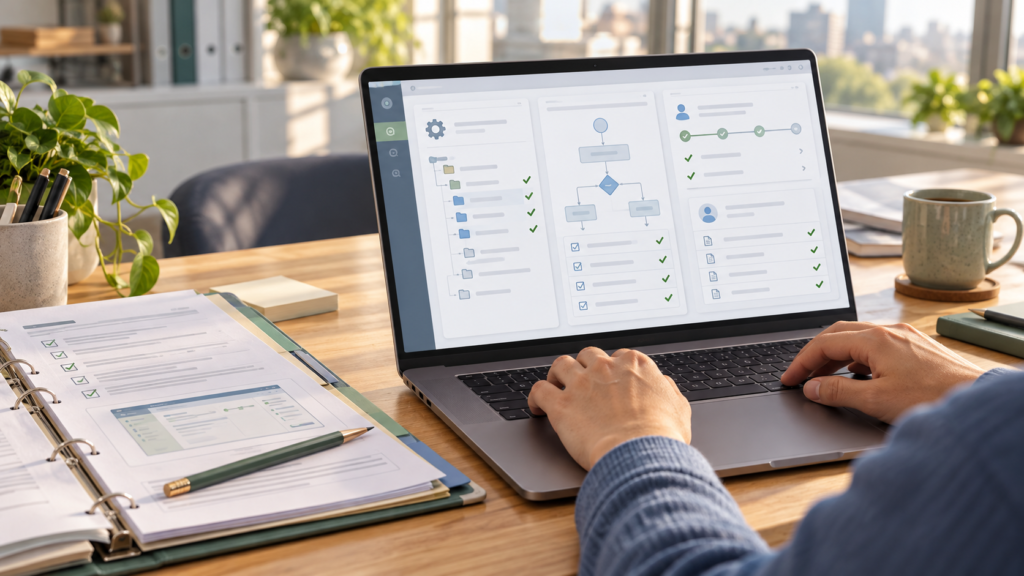
For applicable closed systems, Part 11 describes secure, computer-generated, time-stamped audit trails. Changes must not obscure previously recorded information. ecfr.gov
Test whether an administrator can alter a completion date without leaving a visible history. As an implementation goal, make evidence tamper-evident and protect logs from unauthorized editing. Compliance officers should be able to review change history without broad editing rights. “Immutable” should mean preserving original entries, not preventing legitimate, traceable corrections.
Where electronic signatures apply, signed records must show the signer’s printed name, the signing timestamp and the signature meaning. Verify identity controls, secure authentication, required signature components, linkage between the signature and its record, and role based access controls that protect sensitive data and training data. ecfr.gov
A certificate image or typed name alone does not establish that these controls work. Clear permissions and incident-response procedures reduce potential risks and support regulatory inspections when signature-backed records are reviewed.
Certification management and course versioning
Preserve the exact approved content associated with each completion, and maintain clear certification tracking for every record. When a procedure changes, retain the earlier version and decide whether affected employees need retraining.
Configure certification expiry, renewal assignments and escalation according to the relevant obligation or policy, using deadline management and automated reminders to keep renewals on schedule. Moodle Workplace’s certification documentation, for example, is one of the lms solutions used to manage compliance-sensitive renewals, with expiry dates and recurring certification programs.
Example: An operator completed the previous procedure revision. A new revision changes equipment setup. Keep the historical completion, assign the updated instruction and display the outstanding requirement separately. This kind of automation supports compliance training efforts by assigning updated training modules when content changes.
Compliance tracking that exposes compliance gaps
Define your reporting population before calculating completion rates. Include employees assigned to the relevant role, location and procedure version so tracking shows employee progress, course completion, and training gaps clearly across the reporting population. Record approved exemptions and reassignment decisions.
Real time insights into compliance status help teams identify gaps before audits.
Use these checks during a demonstration:
Control | Test to request |
|---|---|
Role-based access | A manager sees permitted team records and cannot edit approved evidence without authorization. |
Content versioning | A historical completion retrieves the original approved course version. |
Renewal rules | Expiry creates the correct assignment and escalation. |
Record integrity | A correction preserves its history and responsible user. |
Evidence export | An exported record retains its context and signature information. |
Recovery | Restored records retain their links and history. |
SCORM support helps standardize e learning courses and ensures interoperability of eLearning content, while xAPI captures a broader spectrum of learning experiences in LMS than completion-only records, which improves evidence quality when reviewing training effectiveness.
These are evaluation scenarios; select and document the ones your risk assessment requires.
Audit-ready reporting and retention
Prepare a record package with comprehensive reporting for audits and regulatory inspections containing:
- Learner identity and role at the relevant time
- Assigned requirement and approved content version
- Completion date, assessment outcome and applicable sign-off
- Corrections, exemptions and supporting audit history
- The compliance data needed to demonstrate current and historical compliance status
Test both readable exports and electronic copies where required. Exports should also support audit reporting for compliance officers and internal compliance teams across business units. Retrieve historical evidence after an employee leaves or an integration changes.
HIPAA-required documentation has a six-year retention rule measured from creation or the date last in effect, whichever is later. Do not apply that period to every record category automatically. Define retention, approved deletion and legal holds separately. HHS.gov
Validation: what it costs to keep a validated system

Validation establishes evidence that the configured system works for its intended use. In an enterprise LMS, validation helps support compliance consistently across integrations and workflows. A supplier’s test package can inform your assessment, but you still need evidence for your configuration, integrations and workflows.
IQ/OQ/PQ is one way to organize that work, rather than a universal document format mandated for every LMS:
- Installation qualification (IQ): document the deployed environment, version, configuration and required dependencies.
- Operational qualification (OQ): verify specified functions, permissions, exception handling and record controls.
- Performance qualification (PQ): demonstrate intended workflows with representative users, data and operating conditions.
FDA’s General Principles of Software Validation recognizes IQ/OQ/PQ as one legitimate organizational approach. For medical-device production and quality systems, its February 2026 software assurance guidance provides a risk-based approach and includes an LMS example. fda.gov
Your validation documentation should include intended use, requirements, risk assessment, supplier assessment, test evidence, deviations, traceability and release approval.
Budget for that work throughout the system’s life. Include change assessment, regression testing, documentation updates and quality review alongside licensing or development costs. Ongoing reassessment of validated controls is necessary as evolving regulations and shifting regulatory standards affect your compliance obligations.
When software changes, assess its effect on the validated state and perform justified testing, especially when updates must be reviewed carefully against changing regulatory landscapes. Revalidation should address the change and affected workflows; it does not automatically mean repeating every original test. fda.gov
Example: A release changes identity synchronization. Check whether departed employees lose access while their historical records remain correctly attributed.
For clinical training environments, Healthcare software testing services can support testing. Keep acceptance criteria and final validation approval with your responsible quality team.
Buying a compliance-ready LMS vs hardening your own
Compare LMS platforms and your existing system against the same evidence scenarios. When organizations compare options, they should evaluate not just audit controls but whether the system can deliver training in ways that engage learners and improve knowledge retention. Before selecting either route, request a demonstration using your course revision, employee transfer and record export workflows.
Many organizations still run training programs that are basic or reactive, and weak engagement can undermine effective compliance training.
Buying a platform is a practical option when your team needs predictable delivery, vendor support and a shorter path to deployment. The right LMS can centralize records, automate reminders and reduce manual admin, but the outcome should go beyond passing audits. Better governance here also creates business value by improving efficiency, trust and readiness across the organization.
Hardening your own system is justified when compliance is tightly tied to internal processes, proprietary rules or specialized approvals. In that case, custom workflows should support compliance training content tied to role-specific obligations, with learning paths or other training methods used only where they clearly help teams meet those requirements.
Cloud LMS shortlist
These examples provide a starting point for compliance training selecting, based on supplier documentation rather than independent compliance certification.
Platform | Documented capability | What to verify |
|---|---|---|
GyrusAim | The vendor describes audit trails, electronic signatures and course versioning. | Demonstrate signature controls, correction history, certification tracking, automated reminders, and the available validation evidence. |
eLeaP | The vendor describes procedure-linked training, revision-triggered assignments and historical records. | Verify which modules and configurations support your required workflows, and whether the system has an intuitive user interface for assigned users. |
Moodle Workplace | Official documentation describes certification expiry and recertification programs. | Assess additional record, signature and validation controls against your requirements, including how current training materials are maintained. |
An lms for compliance training should also support SCORM-based interoperability, updateable content, and controlled access to training materials.
In lms compliance training, interactive quizzes and role playing exercises can improve knowledge retention, and LMS compliance often enhances employee engagement through more interactive training.
A learning platform with the right features can also support continuous learning and stronger training effectiveness beyond one-time required training.
Buying a platform is a practical option when demonstrated functions match your approved process. Before accepting a launch schedule, confirm configuration, migration, identity integration, testing and approval milestones. An available product still needs a controlled implementation.
Hardening your own system is justified when you need specific integrations, established workflows or control over record storage and release timing. Examples include linking approved procedure changes to assignments or transferring qualification status between internal systems.
For a finance team, consider a policy change affecting only employees who handle a particular transaction type. Test whether assignments follow the correct role without exposing unrelated employee records.
Plan custom work around requirements approval, implementation, migration verification, validation and release review. Include ongoing maintenance ownership. If you cannot trace existing records to their original content or recover change history, evaluate replacement alongside extension.
Use the Custom LMS development guide to structure that decision.
Choose the route that gives you demonstrable controls and an operating process your team can maintain.
Leave a Reply