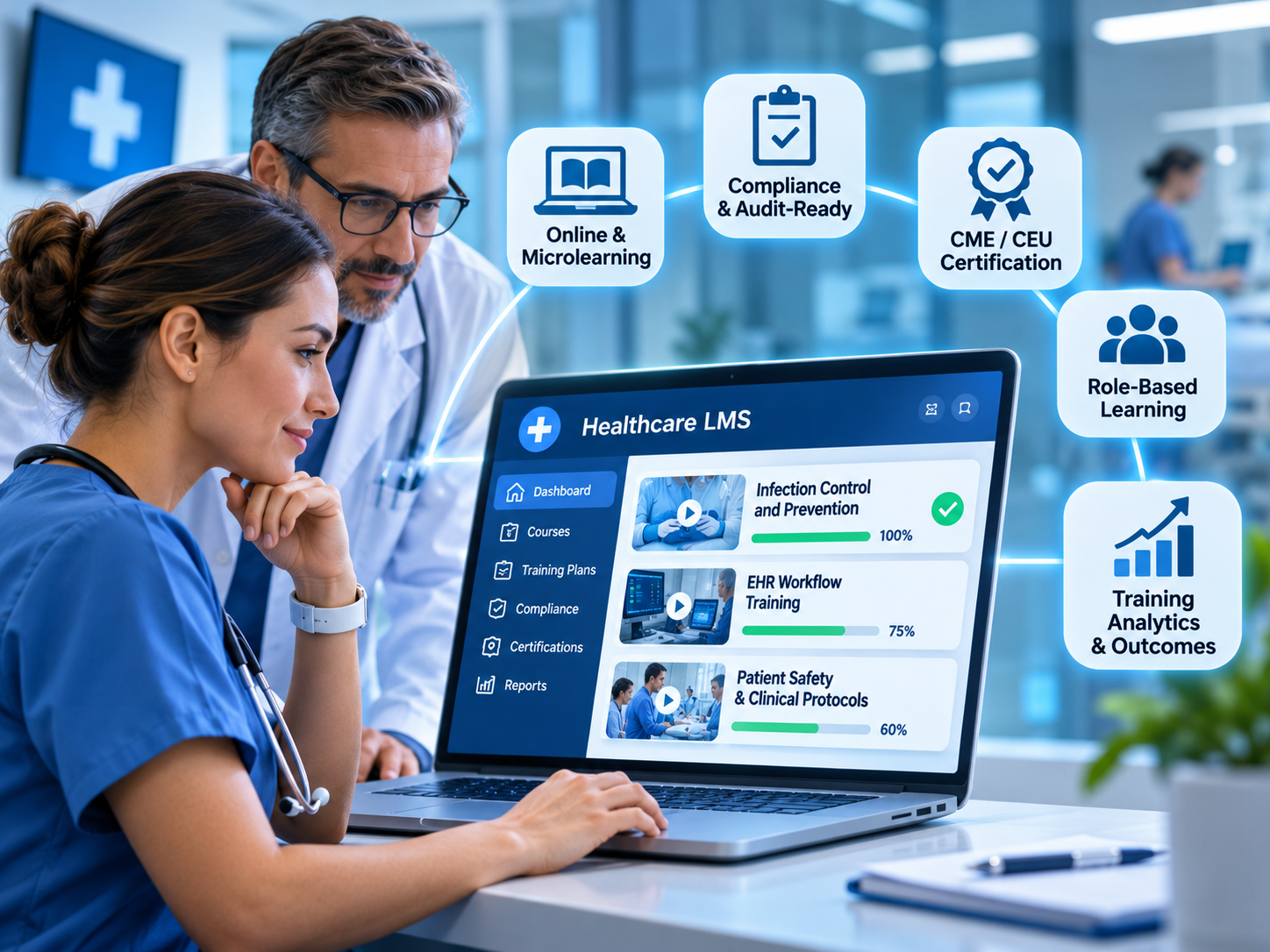
Introduction to Healthcare LMS Systems
Healthcare organizations operate under a weight that most industries never face: every gap in staff knowledge can translate directly into patient harm. Post-COVID staffing shortages, telehealth expansion across state lines, and a regulatory environment that adds requirements faster than it removes them have made ad-hoc training unsustainable. Healthcare LMS systems exist to solve that problem – centralizing the digital delivery of healthcare training and medical training at scale, across roles, facilities, and time zones.
A well-designed healthcare learning management system does more than host courses. It directly influences patient outcomes by ensuring clinical staff demonstrate competence – not just attendance – before they touch a patient. It keeps organizations audit-ready for Joint Commission, CMS, and state surveys. And it gives a distributed, shift-based workforce a realistic way to stay current without pulling them off the floor for eight-hour classroom sessions.
WTT Solutions builds these platforms as a custom healthcare LMS software development partner. We are not selling a boxed product. We design, architect, and deliver learning management systems tailored to an organization’s regulatory environment, integration landscape, and clinical workflows.
The rest of this article breaks down what matters in a healthcare LMS: streamlined compliance management that survives audits, personalized learning paths that respect clinicians’ time, integration capabilities that eliminate double data entry, and measurable impact on patient care tied to real operational metrics.
What Is a Healthcare Learning Management System?
A healthcare learning management system is a software platform purpose-built for the healthcare sector. It creates, delivers, and tracks training programs for clinicians, non-clinical staff, and the extended workforce – locum physicians, volunteers, vendors, and home health aides. Unlike generic learning management systems used in corporate settings, a healthcare LMS treats credentialing, continuing education, and audit-ready reporting as core workflows, not bolt-on features.
The platform centralizes content libraries covering clinical protocols, HIPAA privacy training, infection control procedures, and medical device operation. It automates assessments and certification tracking, distinguishing between course completion and demonstrated competence. Healthcare LMSs offer thousands of accredited courses and tests, and they can issue credits and certificates for continuing education – CME, CEU, and state-specific requirements. Custom content authoring allows for the creation of tailored learning experiences, while content integration supports pre-built course libraries and custom content creation side by side. The system supports both online courses and interactive content, from scenario-based simulations to policy acknowledgment workflows with version control.
Concrete examples of training types delivered through these platforms include sepsis bundle protocol updates, new EHR workflow rollouts, telemedicine etiquette for cross-state consultations, and radiation safety recertification for imaging technologists. Each of these carries different regulatory weight, different audience segmentation, and different assessment requirements – exactly the complexity a healthcare LMS is designed to handle.

Why Healthcare LMS Systems Matter for Patient Outcomes
The connection between up-to-date healthcare training and clinical quality is not abstract. Improved patient safety results from regular training and updates on clinical protocols. When catheter insertion protocols are reinforced through mandatory microlearning, catheter-associated urinary tract infection rates drop. When medication administration procedures are standardized through competency assessments rather than annual slide decks, medication error rates follow the same trajectory. Healthcare LMS platforms improve clinical competency and patient outcomes by making guideline adherence systematic rather than aspirational.
Analytics from a learning management system allow leaders to move beyond “training hours completed” toward competency and outcome-based metrics. The system can flag which units fail assessments at higher rates, then correlate that data with quality indicators – falls, readmission rates, patient satisfaction scores. That correlation turns training from a checkbox exercise into a targeted intervention. Healthcare providers gain the ability to identify competency gaps tied directly to safety events and address them before the next survey or sentinel event.
Key Benefits of Healthcare LMS for Organizations
The benefits of healthcare LMS adoption extend well beyond regulatory box-checking. Here are the operational returns that justify the investment:
- Compliance management at scale. A healthcare LMS automates compliance tracking and reporting, mapping mandatory training to roles, departments, and facilities. Automated reminders reduce administrative burden on healthcare staff, and automated course assignments save time for healthcare administrators who previously chased spreadsheets.
- Significant cost savings. Healthcare LMS reduces training costs by eliminating in-person sessions – less travel, less overtime for backfill, fewer rented conference rooms. One multi-facility health system reported reducing audit preparation time from roughly a week to under a day after centralizing compliance reporting.
- Operational agility. During COVID-19 surges, organizations with functioning LMS infrastructure pushed updated infection control protocols to thousands of staff within hours. That same agility applies to new RSV vaccine guidelines, EHR upgrades, or any clinical protocol change that cannot wait for the next quarterly in-service.
- Retention and professional development. With national RN turnover hovering around 17.6% and newly hired RNs leaving at 22.7% within their first year – at a replacement cost of roughly $60,000 per nurse – engaging learning pathways improve retention and applicability of training. Clear career paths through continuous professional development keep staff engaged.
- Standardized onboarding across facilities. In multi-hospital networks, standardized onboarding ensures consistent training delivery across staff regardless of which facility they join. No more facility drift where one site operates on outdated checklists.
- Patient-facing education. LMS platforms can host structured patient education modules for chronic conditions like diabetes or heart failure, improving adherence and reducing preventable readmissions.
Healthcare LMS centralizes training data for easier management, giving leadership a single source of truth across the entire organization.
Core Features of Modern Healthcare LMS Platforms
Buyers and IT leaders evaluating healthcare LMS software should test these capabilities against real workflows, not demo scripts:
Course and curriculum management must support versioning so that when clinical guidelines update, the system re-assigns affected modules automatically. Prerequisites enforce sequencing – a nurse cannot access the advanced hemodynamic monitoring module before completing the basics. Blended learning paths combine online training with in-person simulation labs and scenario-based modules with branching clinical logic.
Assessment tools go beyond multiple-choice quizzes. OSCE-style checklists, skills validation workflows, and supervisor sign-offs tied to competency frameworks ensure that demonstrated performance – not just knowledge recall – is documented. Competency assessments help identify knowledge gaps and direct refresher training where scores decline. Reporting and analytics generate compliance reports and competency assessments on demand.
Healthcare LMSs provide personalized learning paths for staff, differentiating what an ICU nurse needs from what a radiology tech or home health aide requires. Paths adjust by role, experience level, facility, and specialty. The platform should handle multiple content formats: video, interactive simulations, SCORM/xAPI packages, PDFs, podcasts, and clinical decision trees.
Security and privacy features are non-negotiable: role-based access controls, SSO integration, audit logs capturing who accessed what and when, encryption at rest and in transit, and data retention policies aligned with HIPAA and GDPR. Credentialing management tracks individual certifications and license expirations, blocking scheduling or assignment when critical credentials lapse.
Flexible Learning Options for Busy Healthcare Professionals
Shift work and 24/7 operations make rigid training schedules impractical for most healthcare workers. A nurse finishing a twelve-hour night shift will not attend a 9 AM lecture. The LMS must meet clinicians where they are – literally.
Microlearning modules of five to ten minutes fit into shift handovers, quiet stretches on the ward, or gaps between outpatient appointments. Mobile accessibility allows healthcare staff to complete training on mobile devices, and mobile-first design is crucial for training accessibility across shifts. Mobile learning allows healthcare professionals to learn anytime, anywhere – in the break room, on the commute, or between home health visits. Over 4,000 healthcare companies use iSpring LMS for mobile learning, and healthcare LMS platforms enable on-the-go access to training materials regardless of location. Mobile access enhances training efficiency for busy healthcare professionals and supports self-directed education in healthcare settings.

Online and offline sync options matter for remote or low-connectivity environments – rural clinics and home health staff in the field cannot depend on stable broadband. Self-paced learning blended with mandatory deadlines lets staff learn at their own pace while compliance requirements enforce hard cutoffs. Accessibility considerations include WCAG-compliant design, captions for video content, screen reader support, and multilingual options for diverse workforces. Healthcare LMSs support mobile learning for on-the-go access, and mobile learning allows healthcare professionals to train on-the-go without sacrificing clinical coverage.
Compliance Training and Credentialing Simplified
Compliance is the single strongest business driver for adopting healthcare LMS software. Manual tracking – spreadsheets, email reminders, paper sign-off sheets – introduces risk at every step. Streamlined compliance reduces risks associated with manual tracking by replacing human memory with automated workflows.
Regulatory frameworks vary by region. In the US, HIPAA, OSHA, CMS conditions of participation, and Joint Commission standards each impose distinct training requirements. The EU layer adds GDPR and national infection-control mandates. An LMS helps organizations comply with HIPAA and OSHA regulations by mapping courses to specific roles, licenses, and credentials. An RN license renewal triggers different modules than a radiology tech’s radiation safety recertification.
Healthcare LMS automates compliance tracking and reporting tasks, issuing automated reminders that ensure staff complete required compliance training on time. When deadlines pass, the system escalates to managers. Healthcare LMS provides audit-ready compliance reports on demand – filterable by department, role, location, or date range – with digital proof of completion and historical records retained even after credentials expire. LMS tracks staff competencies to ensure regulatory compliance across the organization.
Consider a hospital system preparing for a Joint Commission survey. Without centralized tracking, collecting training evidence across multiple facilities takes days. With a healthcare LMS, that report is a single pull. Over 1,200 organizations use Open LMS for healthcare training, leveraging exactly this kind of centralized compliance visibility.
WTT Solutions builds custom compliance dashboards and rule engines aligned with an organization’s internal policies, accreditation bodies, license types, and state-specific regulations – configurations that off-the-shelf platforms rarely handle without workarounds.
Analytics, Reporting, and Identifying Training Needs
Data-driven decisions separate effective healthcare learning management from expensive guesswork. Without analytics, an organization knows who completed a course but not whether the training changed anything.
Standard LMS analytics cover completion rates, test score distributions, time spent per module, drop-off points, and heatmaps for interactive content showing where learners struggle. Training needs assessments help identify compliance challenges and role-specific requirements before gaps become incidents.
The real value emerges when leaders correlate training data with operational KPIs. Link assessment failures to safety incidents – falls, medication errors, infection rates – and suddenly the learning environment becomes a diagnostic tool for operational risk. Dashboards for different stakeholders serve different needs: HR tracks compliance status and credential expiry, clinical education teams monitor skills gaps and assessment performance, and executives see workforce readiness and compliance risk at the strategic level.
Predictive analytics and AI use cases are maturing. Systems can flag at-risk learners showing declining assessment scores and recommend refresher modules automatically, closing knowledge gaps before they manifest clinically. Ongoing feedback and analytics are essential for continuous improvement of training programs, turning static curricula into adaptive, continuously refined learning initiatives.
WTT Solutions integrates LMS analytics with existing BI tools like Power BI and Tableau, connecting training data with hospital data warehouses for unified reporting across clinical, financial, and workforce domains.
Integration Capabilities with Healthcare and Enterprise Systems
Integration capabilities are critical because a healthcare LMS that operates in isolation creates the same data silos it was supposed to eliminate. Double data entry, misaligned staff rosters, and training assignments that do not reflect actual roles waste time and introduce compliance risk.
A healthcare LMS should integrate with existing hospital systems like HRIS or EHR. Integration with HR and EHR systems automates course assignments and tracks employment changes – when a nurse transfers from med-surg to ICU, the system updates training requirements automatically. Typical integrations with HRIS and HCM platforms like Workday, SAP SuccessFactors, and Oracle pull job roles, org structures, and employment status into the LMS in real time.
EHR and EMR integration scenarios with Epic, Cerner, or MEDITECH trigger training when new modules go live or link procedural reference videos directly inside clinical workflows. SSO and identity management integrations with Azure AD or Okta provide secure access controls and automatic role updates, eliminating separate login credentials. Interoperability standards like HL7 FHIR and xAPI help exchange competency data across systems.
WTT Solutions builds custom APIs, middleware, and event-driven architectures to synchronize LMS platforms with existing tech stacks – including legacy systems that lack clean APIs but still hold critical workforce data.

Common Use Cases for Healthcare LMS Systems
A single healthcare LMS can support multiple training programs within one organization, serving audiences from day-one hires to external partners.
New employee onboarding. Healthcare LMS streamlines onboarding for new employees by structuring orientation, safety training, code of conduct, EHR basics, and department-specific modules into role-based paths. A structured LMS onboarding path boosts employee confidence and accelerates time to independent practice. Over 1,200 organizations use Open LMS for onboarding training, and healthcare LMS reduces onboarding time by 45% for new hires. Standardized onboarding ensures consistent training delivery across staff regardless of facility.
Continuous professional development and career ladders. Nurse residency programs, advanced practice certification prep, and leadership training for charge nurses all run through the same platform, supporting ongoing education and clear progression.
Medical device and technology training. Vendor-neutral modules paired with device-specific competency checks on infusion pumps, ventilators, and imaging equipment ensure medical professionals maintain clinical skills and demonstrate proficiency on the equipment they actually use.
Patient and caregiver education. Chronic disease management modules, discharge instructions, and pre-op and post-op education delivered via portals or mobile apps extend the LMS beyond the workforce to improve patient care directly.
Extended enterprise training. Home care agencies, external vendors, university affiliates, and contracted specialists access training through secure, branded portals with data separation and limited access controls – all on the same infrastructure.
Build vs. Buy: Off-the-Shelf Healthcare LMS vs. Custom Solutions
Off-the-shelf healthcare LMS products deploy faster. They include prebuilt course libraries, predictable licensing models, and vendor-managed updates. For a single-site clinic with straightforward compliance requirements, a commercial platform may be enough.
The constraints appear at scale and complexity. Commercial platforms impose fixed workflows that may not match an organization’s credential and licensure cycles. Integration with existing hospital systems often requires expensive professional services or custom middleware the vendor controls. Licensing costs compound across facilities and user tiers. Training content may not reflect your specific clinical protocols or state-level regulatory requirements.
Custom development with a partner like WTT Solutions aligns the platform with unique training needs, builds deep integration into hospital systems, and gives the organization ownership over its roadmap and data. This approach is justified for large multi-hospital groups, telehealth platforms operating across jurisdictions, or international medical organizations with complex compliance matrices. A hybrid approach also works: extend an existing commercial LMS with custom modules, microservices, or mobile apps built by WTT Solutions to fill the gaps that matter most.
How WTT Solutions Designs and Delivers Healthcare LMS Platforms
WTT Solutions is a healthcare-focused custom software development company with deep experience in regulated environments – HIPAA, GDPR, SOC 2, and clinical accreditation standards.
Our typical engagement follows a structured path: discovery and requirements analysis with clinical educators and compliance officers, UX research with the clinicians who will actually use the system, technical architecture design, iterative development in two-week sprints with stakeholder demos, and pilot rollouts before organization-wide deployment. We build with React, Angular, Vue, Node.js, .NET, Flutter, and React Native, supporting SCORM and xAPI standards for learning content interoperability.
Domain-specific capabilities define our work. We handle PHI securely, design audit-ready logs, build credential management engines, and integrate with EHR and HR systems. In one engagement, we helped a multi-facility health system replace a legacy training platform with a custom LMS that consolidated compliance tracking across twelve sites and cut audit preparation from days to hours. In another, we built a mobile-first training application for a home health organization operating in low-connectivity rural areas, enabling offline learning with automatic sync. A third project involved designing a custom credentialing engine for a telehealth platform that operated across multiple states with different CE requirements.
If your current learning environment is not meeting your compliance requirements or your staff’s training needs, we should talk about what a tailored healthcare learning management solution looks like for your organization.

Best Practices for Implementing a Healthcare LMS
Align training with organizational goals. Define what you are trying to move – infection rates, readmission numbers, credential audit findings, patient satisfaction – before designing the LMS strategy. Training programs without clear targets produce activity without outcomes.
Involve the right stakeholders early. Clinical educators, IT, compliance officers, nursing leadership, and HR each bring requirements that surface problems before they become expensive rework. Training needs assessments help identify compliance challenges and role-specific requirements across departments.
Build a content strategy that stays current. Mix microlearning, simulations, and longer courses. Define a content review cycle – annually at minimum, sooner when protocols or medical knowledge updates. Educational materials that drift out of date undermine the entire system’s credibility.
Manage the change, not just the technology. Effective LMS implementation requires a change management and support strategy. Pilot with a receptive unit, build a super-user network, communicate benefits clearly, and migrate gradually from old systems. Phased implementation allows for testing workflows and addressing issues before full deployment.
Close the loop with data. Use analytics, learner feedback, and incident data to refine training content and personalized learning paths continuously. The best learning management systems treat implementation as a starting point, not a finish line.
Conclusion: Elevating Healthcare Training with the Right LMS Strategy
Specialized healthcare LMS systems improve compliance, workforce skills, and patient outcomes – but only when the platform fits the organization’s actual workflows, regulatory landscape, and integration requirements. A system that looks impressive in a demo but cannot produce an audit-ready report by department or sync with your HRIS is not solving the problem.
The key factors that separate effective implementations from expensive shelf-ware are integration capabilities that eliminate data silos, robust analytics that connect training to clinical quality, and user-centric design that respects busy schedules and shift-based work. Healthcare firms that treat their learning platform as clinical infrastructure – with the same rigor they apply to EHR selection – see measurable returns in patient safety, staff retention, and regulatory readiness.
Before selecting or building a healthcare LMS, assess your current training needs, map your legacy systems, and define what better patient outcomes actually look like for your organization. If you are ready to plan or modernize your healthcare learning management platform, WTT Solutions can help you design a solution built around your compliance, credentialing, and clinical training reality – not someone else’s template.
Leave a Reply