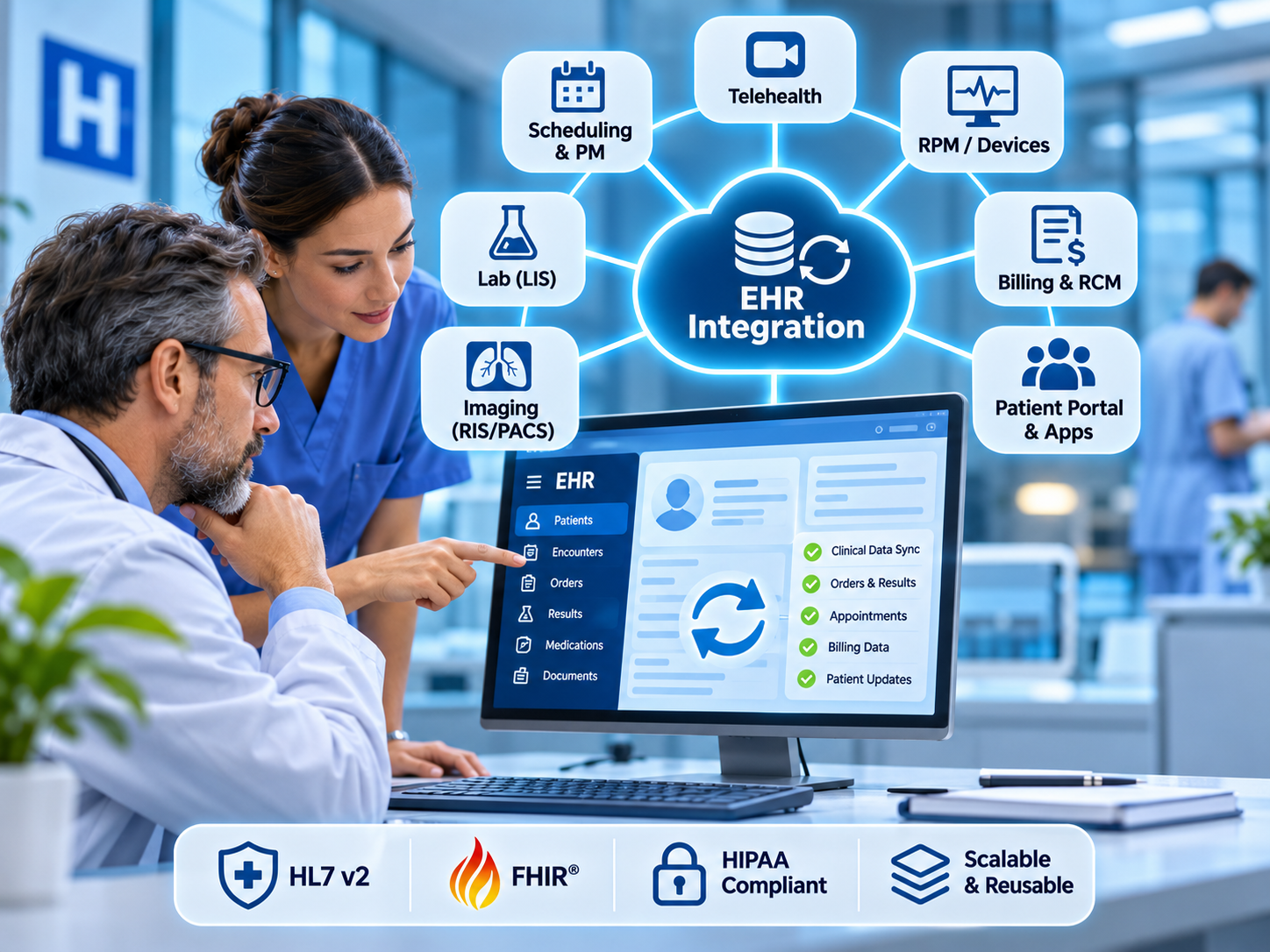
Finally, EHR Integration Solutions Built for Modern Healthcare Providers and Digital Health Teams
EHR integration solutions connect electronic health record systems – like Epic, Cerner, athenahealth, eClinicalWorks, and NextGen – with the other applications, devices, and platforms that healthcare organizations depend on daily. These integrations allow patient data, clinical observations, lab results, scheduling updates, and billing data to flow between systems automatically, eliminating the fragmented silos that force clinicians into inefficient workarounds.
The problem is that most healthcare organizations struggle to make this work. Fragmented patient data across multiple systems means providers rarely see a complete medical history in one place. Duplicate data entry consumes hours every week as staff toggle between an EHR, a telehealth platform, billing systems, and practice management software – a painful swivel-chair workflow that drives errors and burnout. Slow IT queues, vendor bottlenecks, and failed integrations only compound the frustration. Only 44% of clinicians feel their EHR integrates well with external systems, and 50% of patient records are mismatched without a national identifier. These aren’t edge cases – they’re the norm.
This page is for health systems, multi-site ambulatory practices, and digital health product teams that need reliable, standards-based integration with major EHR platforms. WTT Solutions is a healthcare-focused software partner that designs and builds custom EHR integration solutions – not an EHR vendor, but an engineering team with deep healthcare domain expertise in HL7 v2, HL7 FHIR, REST APIs, and custom adapters. Our core promise: launch safe, compliant EHR integrations in months instead of years, without derailing clinical workflows or failing security reviews.
Here’s why our approach to EHR integration works when one-off interfaces don’t.
Why WTT Solutions’ EHR Integration Services Work
Point-to-point interfaces solve one problem at a time and create a brittle web of connections that break with every EHR upgrade or new system addition. A strategic integration layer, paired with managed EHR integration services, replaces that fragility with a scalable foundation. Effective EHR integration solutions connect disparate healthcare software for a unified ecosystem – and that’s exactly what WTT delivers.
- End-to-end interoperability architecture – WTT designs the complete data flow between EHR systems, telehealth platforms, RPM devices, laboratory information systems, billing systems, and patient-facing apps. Instead of wiring a single interface, we map how patient information, orders, results, and encounters move across your entire ecosystem – enabling seamless data exchange rather than isolated connections.
- Deep healthcare data standards expertise (HL7 v2, FHIR R4, X12, CCD/C-CDA) – HL7 is the older messaging standard for healthcare data; FHIR is a newer standard using modern web technology. Using FHIR and established HL7 standards enables reliable data exchange between different EHR platforms. WTT builds integrations aligned with the 21st Century Cures Act – which mandates open data sharing in healthcare – along with ONC, CMS, and HIPAA requirements, ensuring standardized communication across every connection.
- Clinical workflow-first design – Every integration is mapped to real provider workflows: order–result cycles, ePrescribing, scheduling systems, authorizations, and quality reporting. Focusing on workflow usability helps prevent clinician burnout in EHR use. We design so clinicians gain capabilities, not extra clicks.
- Security and compliance baked in – Data security is a major consideration during EHR integration due to increased connections between systems. Every WTT project includes encryption in transit and at rest, role-based access control for protecting patient privacy, multi-factor authentication, detailed audit trails, and BAAs. We work across regulated environments in the US and EU as standard practice.
- Scalable, reusable integration layers – WTT builds normalization layers and reusable APIs so that each new clinic, hospital, or EHR connection is faster and cheaper than the last. The use of middleware can facilitate data translation between diverse healthcare systems, and our approach reduces marginal cost dramatically as you grow.
- Flexible engagement model – WTT can deliver turnkey custom EHR integration development projects or augment your in-house IT teams with specialized healthcare engineers who understand PHI, clinical workflows, and healthcare integration at the protocol level.
How Our EHR Integration Solutions Work (Step-by-Step)
WTT follows a repeatable, low-risk implementation process for every EHR integration project. Phased deployment helps to manage disruptions in healthcare systems integration – and each phase below is designed to minimize risk while maximizing speed to value.
Step 1: Discovery, Compliance Review, and Integration Blueprint
We begin with structured workshops that bring together clinical, operations, IT, and compliance stakeholders. The goal is to understand your current systems – whether that’s Epic plus a telehealth platform plus a third-party billing engine, or multiple EHR systems across acquired facilities – and map the pain points, data flows, and business goals in concrete detail.
Technical discovery follows: which EHR(s) are in play, what integration capabilities exist (FHIR APIs, HL7 feeds, flat files, vendor-specific interfaces), and what constraints apply – rate limits, API versions, sandbox access, and interface engines already in place. Integrating electronic health records requires overcoming fragmented data silos and legacy infrastructure, and we identify those barriers early.
Compliance and security review happens up front, not as an afterthought. We assess HIPAA obligations, GDPR requirements (if relevant), organization-specific security policies, and BAA needs. Establishing patient identity matching protocols is critical for effective EHR integration, so we evaluate EMPI strategies and identity governance as part of discovery.
The outcome: a concrete integration blueprint with data flows, message types, data mapping scope, estimated timelines (typically 3–6 months for a first major EHR integration), and a risk register that everyone signs off on.
Step 2: Build, Normalize, and Test EHR Integrations
WTT engineers implement connectors using the best available options for each scenario – HL7 v2 interfaces for ADT and orders, FHIR R4 APIs for modern patient demographics and clinical data reads/writes, proprietary EHR APIs where needed, or custom adapters for legacy systems. Enterprise integration engines help route messages reliably between legacy systems and new EHR platforms throughout this phase.
A central normalization layer standardizes patient, encounter, orders, and results data models. This means other services – patient portals, analytics dashboards, AI models – can consume clean, consistent healthcare data regardless of which source EHR produced it. Data quality management is crucial to ensure accurate patient records in EHR systems, and this layer is where we enforce it.
Data mapping and terminology alignment are handled systematically: mapping local lab codes to LOINC, diagnoses to ICD-10/SNOMED, medication vocabularies to RxNorm. Poor data mapping is a leading cause of integration failures, and we treat it as an ongoing service, not a one-time task. Real-world case studies show facade systems requiring mapping of over 4,700 codes initially, with nearly 2,000 additional codes surfacing after go-live – so our process is built for continuous refinement.
Multi-stage testing follows: synthetic data in development, QA/staging against EHR sandboxes, security testing, and user acceptance testing with clinicians running realistic scenarios. Data cleansing and migration strategies prevent “trust killer” go-live failures in EHR implementations. We collaborate closely with the EHR vendor’s integration team and hospital IT to pass security and change-control processes before anything touches production.
Step 3: Go-Live, Monitoring, and Continuous Optimization
Controlled rollout is non-negotiable. We start with pilot sites or limited user groups – one clinic, one specialty, one workflow – with rollback and contingency plans ready. This approach manages risk while generating immediate proof of value.
Real-time monitoring is set up for message queues, error rates, latency, and uptime, with automated alerting for failed interfaces or degraded performance. Real-time data access enhances clinical decision-making efficiency, and monitoring ensures that access stays reliable. Ongoing staff training is necessary to minimize disruption during EHR integration, so we provide documentation and training for internal IT teams and clinical “super users.”
Post-go-live optimization addresses edge cases, adds new message types or workflows, and prepares your systems for future EHR API and version changes. WTT can provide ongoing support as a managed service or hand everything over to your internal teams with a clear runbook and knowledge transfer.
What Makes Our EHR Integration Solutions Different
Many EHR integration vendors sell tools or middleware licenses. WTT Solutions delivers custom solutions plus the engineering capacity to make them work in your specific environment.
- Healthcare-native engineering teams – WTT’s teams bring deep experience across healthcare, EdTech, HRTech, and MarTech, with dedicated engineers who understand sensitive patient data, clinical workflows, and healthcare regulations. This isn’t generalist outsourcing – it’s healthcare domain expertise applied to every interface.
- Custom software mindset, not “one-size-fits-all” middleware – We build custom EHR integration solutions tailored to each organization’s stack – web, mobile, AI services – instead of forcing a generic connector product that can’t match your workflows. Many EHR vendors use proprietary protocols hindering integration, and our custom development approach works around those limitations.
- Full-stack expertise across the ecosystem – WTT engineers work in React, Angular, Vue, Node.js, .NET, Flutter, and React Native, integrating EHR data directly into clinician- and patient-facing applications. This means your patient engagement apps, practice management solution, and clinical dashboards all draw from the same integrated data layer.
- AI and workflow automation embedded into integrations – Once healthcare data flows reliably, WTT can layer AI capabilities – clinical summarization, risk scoring, document extraction – on top of integrated systems. Automated workflows reduce manual data entry and improve administrative efficiency in EHR integration, turning raw data exchange into actionable intelligence.
- Outcome-based delivery and measurable ROI – We track specific improvements: reduction in manual data entry time, fewer claim denials through streamlined billing processes, faster prior-auth turnaround, improved data accuracy. EHR integration can reduce overall healthcare costs for providers, and we prove it with metrics, not vague promises.
Proof That Our EHR Integration Solutions Deliver
Healthcare organizations and digital health companies work with WTT to reduce time-to-integration and improve reliability across their connected ecosystems. EHR integration costs can vary significantly based on complexity, but the ROI evidence from successful implementations is compelling. The healthcare interoperability market was valued at $6.68 billion in 2025 – and that investment is paying off for organizations that integrate strategically.
- US multi-specialty clinic network – Integrated its existing EHR with a new telehealth platform and patient mobile app. By eliminating duplicate data entry for visit notes, charges, and patient demographics, the network reduced average visit documentation time by approximately 25%. EHR integration reduces manual data entry errors by 50% in comparable implementations, and integrated systems streamline billing processes and reduce claim denials.
- EU-based digital health startup – Connected a chronic-disease management app to multiple EHR systems via FHIR and custom APIs. By building a reusable normalization layer, the startup cut onboarding of new hospital or health system partners from approximately 9 months to 3–4 months – a successful EHR integration implementation that unlocked faster revenue growth. Custom EHR integration can reduce manual data entry errors significantly, and this project proved it at scale.
- Diagnostic lab provider – Built bi-directional HL7 integration for orders and results with several ambulatory EHRs, replacing fragmented batch file transfers. Result delivery lag dropped from days to near real-time, lowering call-center burden for status checks and improving patient care coordination. EHR integration improves care coordination across multiple providers, and this project demonstrated how reliable data exchange transforms operational efficiency.
Industry benchmarks reinforce these outcomes: a 12-hospital network that unified 47 systems across four EHR platforms eliminated approximately 2,000 manual entry hours per month and reduced transcription errors by 78%. A patient portal redesign cut telehealth no-show rates from 22% to 9% and saved an estimated $1.8M annually in call center costs. Cloud-based EHR architectures allow secure access to centralized patient histories across multiple facilities, and implementing cloud solutions can reduce infrastructure limitations in EHR systems – both patterns WTT applies regularly.
Who Our EHR Integration Solutions Are For
WTT works with both healthcare providers and technology companies that must connect with EHR systems and other clinical platforms to deliver better patient outcomes.
- Hospitals and Integrated Delivery Networks (IDNs) – Need to unify data between a core EHR (Epic, Cerner, Meditech), lab systems, imaging (PACS), revenue cycle platforms, and population health analytics. Interoperability standards are essential for efficient data sharing in healthcare systems at this scale.
- Multi-site ambulatory practices and specialty clinics – Seek to connect EHR systems with practice management software, patient engagement tools, e-prescribing networks, scheduling systems, and telehealth platforms. These organizations need seamless communication between multiple tools without adding burden to medical practitioners.
- Digital health and MedTech startups – Require scalable EHR integration to power new products – RPM, virtual care, AI diagnostics – across dozens of health systems without building an internal HL7/FHIR team. Integrating EHR systems at this scale demands reusable architectures and deep standards expertise.
- Health insurers and value-based care organizations – Want direct, structured clinical data feeds from EHRs for risk adjustment, quality measures, billing data reconciliation, and care coordination. Secure data exchange and patient data privacy are non-negotiable.
- Research, life sciences, and public health teams – Need compliant pipelines from electronic health record systems into research data platforms and analytics environments, with proper de-identification, consent management, and data accessibility controls.
Typical EHR Integration Solution Packages
WTT offers flexible pricing and engagement models rather than rigid SaaS tiers. The packages below reflect common project profiles to help you gauge scope, timeline, and investment. EHR integration costs can vary significantly based on complexity, and we tailor every engagement accordingly.
Essential Integration Package – For a Single EHR Workflow
Ideal for organizations integrating one external app or system with a single EHR – for example, a basic FHIR-based read/write connection to support a new patient portal, telehealth platform, or patient management dashboard.
- Discovery and compliance review
- 1–2 HL7 or FHIR interfaces covering a limited data domain (patient demographics, appointments, encounters)
- Sandbox and production deployment
- Basic monitoring and alerting setup
- Typical timeline: 8–16 weeks depending on EHR vendor processes
- Small WTT engineering squad plus designated client IT contact
Scaling Integration Package – For Multi-System, Multi-Clinic Use
Suited for healthcare organizations connecting several systems – EHR plus billing plus telehealth plus laboratory information systems, or multiple EHR systems across acquired sites – with a shared normalized data layer.
- Integration architecture design
- 4–8 interfaces across multiple systems
- Normalization layer for standardized patient records, orders, and results
- Intelligent message routing and interface engines
- Basic data warehouse or analytics integration for quality reporting and population health
- Comprehensive change management, training, and monitoring automation
- Typical timeline: 3–6 months
Enterprise Integration Platform – For Large Networks and Product Companies
Designed for enterprises or platforms needing ongoing EHR integration as a core capability – digital health vendors connecting to dozens of major EHR systems, or health systems standardizing EHR interoperability across many hospitals after mergers.
- Reusable internal APIs and integration microservices
- Robust normalization and terminology services (LOINC, SNOMED, RxNorm, ICD-10)
- DevOps pipelines with automated testing and deployment
- 24/7 monitoring, alerting, and ongoing support options
- Engagement typically combines project delivery with staff augmentation – dedicated WTT engineers embedded in the client’s team for long-term partnership
Frequently Asked Questions About EHR Integration Solutions
These FAQs address the technical, operational, and business questions buyers commonly ask before starting an EHR integration project.
How long does a typical EHR integration project take from start to go-live?
Simple FHIR-based read integrations – covering patient demographics, appointments, and basic observations – typically go live in 6–10 weeks when EHR sandboxes are accessible and endpoints are mature. Full bi-directional HL7/FHIR integrations involving orders, lab results, scheduling, and messaging usually take 3–6 months. Multi-site or multi-EHR projects with complex data mapping and workflow changes commonly run 6–9 months or longer.
Key factors affecting duration include the number of interfaces, availability of EHR vendor sandboxes, security and compliance review timelines, and the need for clinical workflow redesign. WTT compresses timelines by reusing proven components, adapters, and prior experience with major EHR platforms – one comparable project reduced integration time per EHR from 3 months to approximately 2 weeks by leveraging a pre-built normalization layer.
What healthcare standards and EHR systems can you integrate with?
WTT works across core healthcare data standards: HL7 v2 for legacy message feeds, HL7 FHIR R4 (fast healthcare interoperability resources) for modern API-based data exchange, C-CDA for document-based clinical summaries, X12 for claims and eligibility, and DICOM for imaging when needed.
We have experience integrating with major EHR systems including Epic, Oracle Health (Cerner), athenahealth, eClinicalWorks, NextGen, Meditech, and others via available APIs and interfaces. Redox supports HL7, FHIR, and API-based integrations for EHRs, and WTT can work alongside such platforms or build direct connections. We also integrate with non-EHR systems: laboratory information systems, RIS/PACS, CRM, billing platforms, practice management software, and custom-built applications.
How do you keep EHR integration solutions secure and HIPAA-compliant?
Security and compliance are embedded from day one. Every project includes encryption in transit (TLS 1.2+) and at rest (AES-256), least-privilege access, role-based access control, multi-factor authentication, and detailed audit logging. Data security is a major consideration during EHR integration due to increased connections, and we treat it accordingly.
WTT follows a secure development life cycle (SDLC) with regular code reviews and vulnerability scanning. We sign BAAs when handling PHI and align architecture with each client’s internal security policies and regulatory obligations. Patient data privacy is non-negotiable – our systems are designed so that sensitive patient data never traverses unsecured channels or unnecessary endpoints.
Do we need our own in-house HL7/FHIR experts to work with you?
Internal domain expertise is helpful but not mandatory. WTT supplies HL7/FHIR and integration specialists who can own the technical implementation end to end. What clients should designate: product owners or clinical champions who can define requirements, validate workflows, and provide access to EHR environments.
If your long-term goal is to build internal integration capabilities, WTT can train your teams over time to own more of the integration stack. We frequently transition knowledge and operational responsibility to client engineering teams after successful go-live.
Can EHR integration solutions support AI and advanced analytics use cases?
Absolutely. Once electronic health record data is reliably integrated and normalized, WTT can help feed it into AI models, BI platforms, and data warehouses. Examples include risk stratification dashboards, readmission prediction models, documentation summarization using NLP, and population health analytics for quality reporting.
Special attention is required for de-identification, data governance, and model validation in clinical contexts. We ensure data pipelines respect patient consent, regulatory boundaries, and the data accuracy standards that healthcare professionals depend on for clinical decision-making.
What’s the best way to start if we’ve already had failed EHR integration attempts?
Failed or partial integrations are more common than most healthcare organizations admit. We recommend starting with an integration audit: reviewing existing interfaces, error logs, data mapping coverage, and governance structures to identify what went wrong and what’s salvageable.
From there, we target a narrow but high-impact pilot – fixing one critical interface or workflow – to build trust, demonstrate measurable improvement, and create momentum for broader rollout. WTT focuses on realistic scopes, clear milestones, and incremental deployment to avoid repeat failures. EHR integration ensures better outcomes only when it’s designed for the real world, and that means learning from what didn’t work before.
Get Started With EHR Integration Solutions That Actually Ship
If you’re ready to stop patching fragmented systems and start building EHR integrations that healthcare professionals actually rely on, WTT Solutions is ready to talk. Whether you need to connect Epic to a new mobile app, unify several EHR systems after acquisitions, enable telehealth plus RPM flows, or share patient data reliably across a growing network – we’ve done it, and we can scope it for your specific situation.
Our initial consultations focus on feasibility, risk, and ROI – not a generic sales pitch. We’ll assess your current systems, identify the fastest path to value, and give you a realistic timeline and architecture recommendation.
Book a Healthcare Integration Consultation →
Faster integrations. Safer compliance. EHR-connected experiences that clinicians will actually use – and that drive better patient outcomes across your entire organization.
Leave a Reply