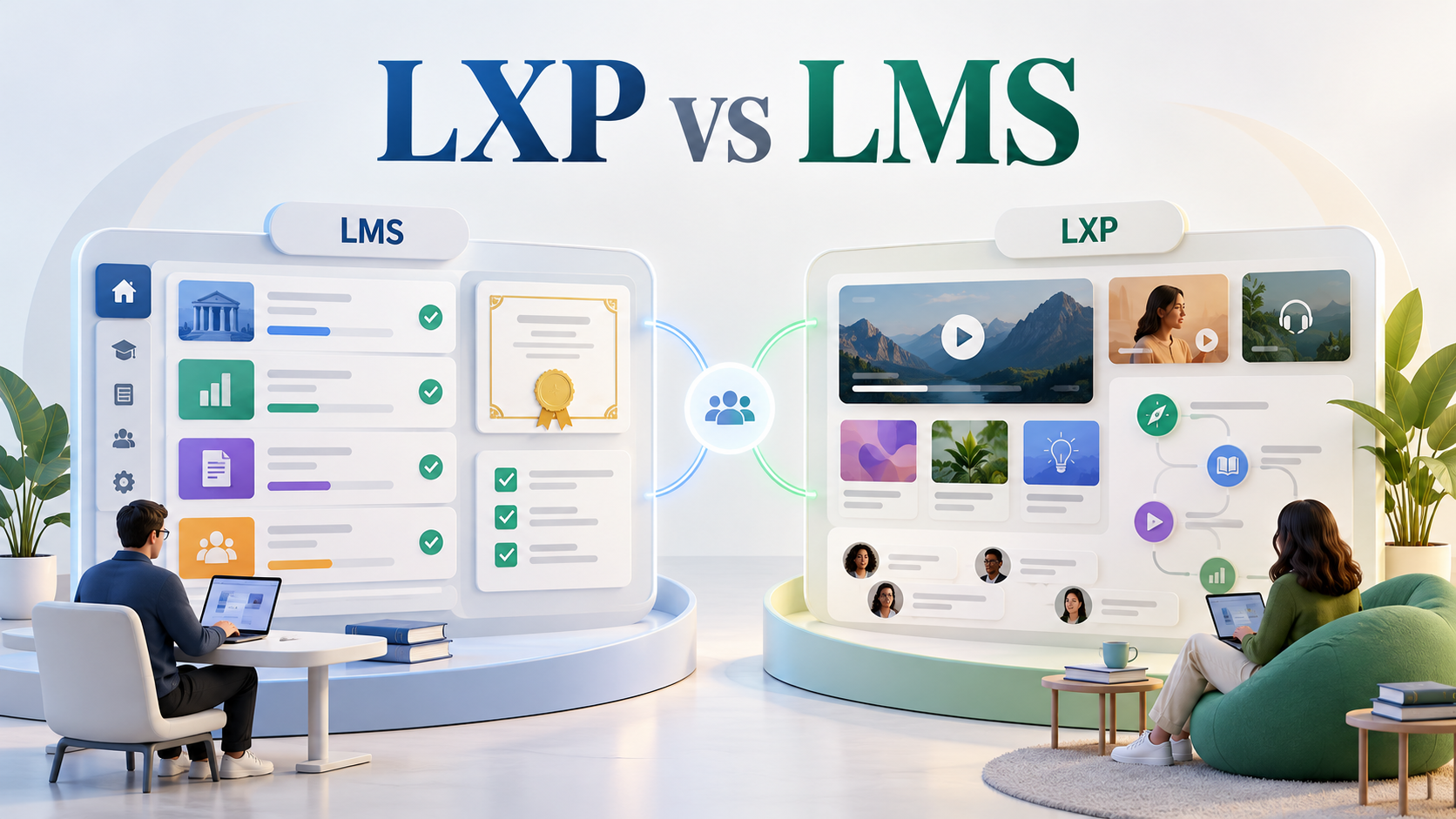
LXP vs LMS in one table
Decision factor | LMS emphasis | LXP emphasis |
|---|---|---|
Learning ownership | Administrators assign courses, deadlines and required sequences | Employees discover resources and choose development goals, with manager guidance |
Content model | Governed courses, assessments and structured training programs | Curated internal resources, external libraries and user generated content |
Discovery | Assigned learning paths and searchable catalogs | Personalized learning, recommendations and exploration across sources |
Compliance | Completion evidence, certification renewal and compliance tracking | Visibility into required learning; verify which connected system holds authoritative records |
Analytics | Learner progress, assessment results and overdue requirements | Learner engagement, content activity and skills data, depending on licensed modules |
Typical buyer need | Training operations, HR or compliance teams accountable for required completion | L&D or talent teams connecting skill development with employee goals |
Capabilities overlap across these design emphases. Moodle Workplace and Docebo illustrate LMS administration and certification workflows. Degreed and Cornerstone LXP illustrate discovery and skills-oriented learning.
Docebo also recommends content and supports informal sharing. Cornerstone LXP includes learning plans with assignments and progress analytics. Evaluate the product and configuration, not just its category label.
For your budget conversation, identify the unresolved workflow first. Can you prove required training happened? Can employees find useful development resources? Those questions give the comparison a practical purpose.
What a learning management system is built to do
In Moodle Workplace and Docebo, a learning management system LMS is the platform organizations use to manage learning in formal training environments through programs, enrollment rules, and certification cycles. This supports essential training with an accountable owner.
Moodle Workplace programs combine courses into learning paths. Its certifications add validity periods and recurring requirements. Docebo documents automated enrollment, renewal notifications, and training management for compliance training. LMS platforms are built for formal training, standardized training, and compliance courses tied to regulatory requirements.
For example, imagine a manufacturer requiring equipment training before an employee operates a machine. Your acceptance test should follow assignment, assessment, certification expiry, and retraining.
Ask each shortlisted vendor to demonstrate:
- How a role change updates required training.
- How managers track training for overdue or expiring requirements.
- How you export completion evidence for review.
Moodle Workplace’s report builder supports filtered reports and scheduled distribution. Specify the evidence your reviewers need instead of accepting a dashboard screenshot as proof. Strong reporting capabilities help teams track progress and export evidence, and some AI features now monitor compliance risks in real time.
LMS platforms deserve evaluation beyond compliance, too. Docebo’s recommendations show that administrator control and personalized learning can coexist, while AI-driven platforms can automate administrative tasks for L&D teams and the LMS focuses on control and accountability. Your learning strategy should define which activities remain required and which employees choose.
If your assignment logic or reporting needs require custom work, the LMS development guide explains the implementation options.
What a learning experience platform adds to a continuous learning culture
A learning experience platform LXP brings LMS catalogs and external content into a discovery environment, and leading LXP platforms use artificial intelligence and machine learning to personalize discovery. Cornerstone LXP combines recommendations, personalized learning experiences and connections with subject matter experts as part of modern learning and workplace learning initiatives. These examples show how employee learning and professional development can become learner driven.
Content curation needs ownership. Decide who reviews shared resources, removes obsolete guidance and maps learning to relevant skills. Even self directed learning needs governance over course content and other shared resources. Cornerstone’s supplier documentation includes employee content creation and sharing, so governance belongs in your evaluation.
For example, imagine a new manager learning to handle difficult feedback. You could combine a curated article, a colleague’s demonstration and coached practice as part of a learner’s learning journey tied to career goals. Test whether the proposed experience platform makes that sequence discoverable and useful.

Design the pilot around:
- A defined skill and an observable workplace task.
- Relevant resources with named content owners.
- Manager feedback after the employee applies the learning.
Degreed documents skill ratings and assessments alongside personalized development, with signals that can reflect learning behavior and support more relevant training recommendations. Use those capabilities to investigate progress; do not equate reading activity with demonstrated competence.
Cornerstone’s social learning features support knowledge sharing and communities of practice. Treat knowledge retention, peer learning and employee engagement as outcomes to assess through later practice, not guaranteed benefits of AI-driven recommendations.
For the category’s broader capabilities and use cases, read the Learning experience platform guide.
Five key differences that change the decision
Use these checks to compare proposals against your actual workflows. Many organizations still struggle to measure learning’s business impact, with 54% reporting this issue, while 74% prioritize linking learning to performance.
Difference | What to verify before approval |
|---|---|
Compliance evidence | Identify the authoritative completion record, renewal logic and exportable evidence. Test required training end to end. |
Content ownership | Name owners for approved courses and employee contributions. Confirm review permissions, update rules and export rights. |
Integration surface | Verify identity, catalog and completion connections. Agree on synchronization frequency, error handling and support responsibility to avoid fragmented learning from multiple tools and disconnected management systems. |
Reporting | Separate completion, participation and demonstrated skills. Request sample exports for each decision your managers must make and how they connect to business objectives. |
Cost of adoption | Request itemized quotes and an internal staffing estimate. Include migration, integrations, content review and employee onboarding in the scope. |
The core difference: accountable evidence
Moodle Workplace’s recurring certifications and Degreed’s required-learning integrations illustrate different responsibilities. One can govern certification cycles; the other can surface assignments held in an LMS. In lms vs learner-driven discovery, the key distinction here is still which platform maintains authoritative records. Ask which system proves completion when records disagree.
Content ownership also means contractual ownership. Ask whether you can export authored material, metadata and learning history when changing suppliers. Do not assume that hosting content grants portability. For enterprise software deals, contracts should also define how data moves to other systems.
Degreed documents separate integration categories for users, catalogs, required learning and completions. A connector’s existence does not answer every implementation question; confirm the data and direction you need for the learning system and any broader learning ecosystem.
Reporting and the learning culture you want
Moodle Workplace supports scheduled reporting, while Degreed offers skill-focused data. Choose measures that answer different questions: who completed a requirement, who participated and who can perform the task, with reporting that supports formal training programs as well as ongoing development.
For example, a support team could finish product training without handling a difficult customer scenario correctly. Add an observed exercise to your pilot so your approval depends on usable capability, especially in a highly regulated industry where proof of capability matters.
For procurement, request a price range for your documented scope. Degreed’s pricing page bases quotes on company needs and headcount. It does not establish a universal LXP benchmark, so reporting should also show whether learning supports business objectives and professional development, not just activity.
When you need both LMS and LXP, and how they connect

For a mature stack serving compliance and continuous learning, some organizations use both an LMS and an LXP to manage training across a unified learning ecosystem. AI-driven platforms can combine LMS and LXP functionalities, but buyers should still verify where records live. Degreed explicitly documents LMS catalogs, required-learning records and completion integrations. This supports that architecture without requiring replacement of the existing LMS.
Connection | Implementation requirement |
|---|---|
SSO | Use a shared identity provider and stable learner identifiers. Handle account provisioning separately from sign-in. |
xAPI statements | Send agreed learning events to a learning record store. Define identifiers, permitted senders and completion semantics. |
Skills taxonomy sync | Map skill identifiers, labels and proficiency scales. Assign an owner for additions and changes. |
Integrated architecture can also reduce the need for multiple tools.
Degreed documents SSO and xAPI support. The xAPI specification requires actor, verb and object; results and context can add meaning, and syncing data helps teams track progress across connected systems. An event such as “employee completed simulation” needs agreed rules before it becomes accepted completion evidence.
Treat skills synchronization as a requirement to verify, not an automatic feature of connecting two platforms. For example, map “customer negotiation” to the same skill identifier before combining assessments across systems.
A decision rule for your learning platform budget
Use these three if-then statements when choosing a learning platform or other learning technology for unresolved workflows and business objectives:
- If required training lacks reliable assignment, renewal or audit evidence, prioritize LMS capabilities. It is the best fit when you need to manage learners, manage learning, and deliver structured learning for formal training. Test those workflows before adding another discovery interface.
- If required training works but development resources are hard to find, evaluate an LXP layer. It can support self-directed discovery and personalized development for employee learning. Test relevant discovery, content curation and skills assessment with an actual team.
- If both needs are material, compare an integrated stack with a product offering both capabilities. Some options combine LMS and LXP functions within one learning system. Approve the option that meets your evidence, adoption and integration requirements.
The right choice depends on your workplace learning priorities, from compliance and essential training to professional development.
Document the current failure, the proposed owner and the acceptance test alongside the budget. Include the consequences of a poor fit: rebuilding connections, repeating migration or leaving the original evidence gap unresolved. That gives stakeholders a reason to approve the work and a way to judge the result.
Leave a Reply