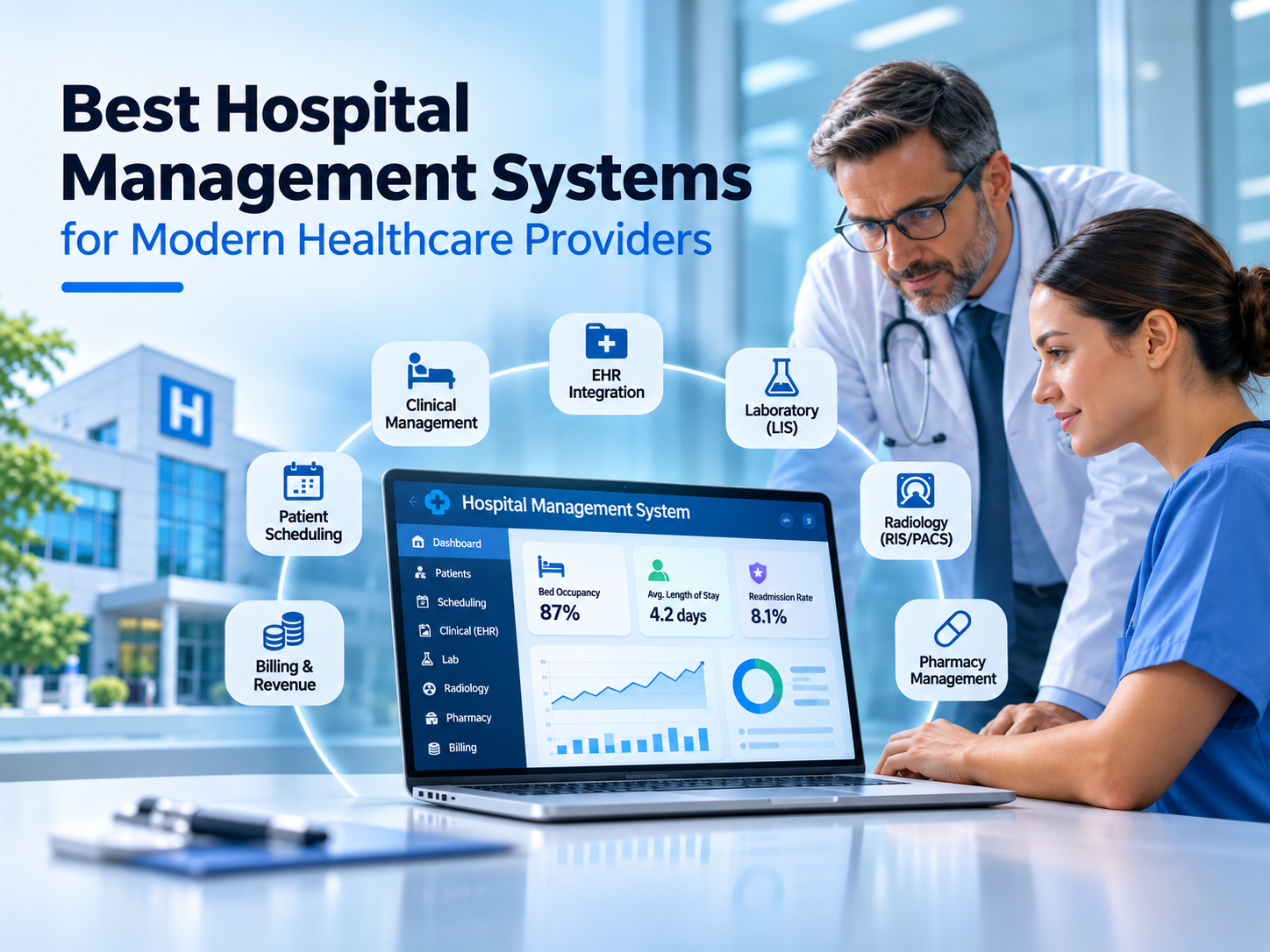
Introduction: Why Hospital Management Systems Matter in 2026
A hospital management system is a digital platform that integrates clinical, administrative, financial, laboratory, radiology, and pharmacy services under one roof. Its job is to unify patient data, automate hospital processes, reduce errors, and give healthcare providers the visibility they need to make faster, better decisions. Before 2020, many hospitals treated these as nice-to-have upgrades. COVID-19 changed that. The pandemic exposed how brittle disconnected systems were – hospitals could not track bed capacity in real time, supply chains collapsed without warning, and remote access barely existed. There was a 78 times increase in telehealth usage during the COVID-19 pandemic, and most healthcare systems were not ready for it. Ongoing staffing shortages and clinician burnout have only accelerated the push since.
This article ranks the best types and implementation approaches for hospital management systems serving hospitals, networks, and clinics in 2026. It does not promote competing vendor brands. WTT Solutions focuses on custom, interoperable hospital management system development rather than off-the-shelf tools, and that perspective shapes the evaluation – but the goal is to help you pick the right model for your facility, not to sell you a single answer.
Options were selected based on real adoption between 2020 and 2026, demonstrated support for EHR integration, regulatory compliance with frameworks like HIPAA and GDPR, scalability across facility sizes, and fit for different budget realities. “Best” here means safest for patient data, most effective for workflow automation, and most realistic to implement given budget constraints and legacy systems. Hospital management systems reduce operating costs and improve revenue cycles – but only if the approach matches the organization.
How We Evaluated Hospital Management System Options
Hospital CIOs and CMIOs do not pick systems from feature checklists. They evaluate against clinical outcomes, staff satisfaction, compliance mandates, integration complexity, and total cost of ownership. The assessment below focuses on system type and implementation model – custom versus off-the-shelf versus hybrid – rather than naming specific competing vendors.
Clinical and Operational Performance
The first filter is whether the system improves measurable outcomes. Metrics that matter include reduction in average patient wait time, fewer medication errors, shorter length of stay, emergency department throughput, and readmission rates. Healthcare providers spend 35% of their time capturing patient data – a hospital management system that fails to cut that number is not pulling its weight. Electronic medical records manage patient data efficiently when implemented well, but the gains only compound when the system connects clinical documentation to scheduling, lab results, and billing in a single workflow.
Analytics dashboards that monitor key performance indicators for healthcare facilities are no longer optional. A scoping review of hospital performance metrics found that average length of stay, nosocomial infection rate, patient satisfaction, mortality rate, bed occupancy, and incidents or adverse events rank among the most frequently tracked indicators. Predictive analytics can reduce rehospitalization rates by identifying at-risk patients before discharge, and automation in healthcare can reduce medical errors and improve patient outcomes. Hospital management systems streamline workflows for quicker diagnoses and treatments – but only if interoperability with existing EHR, EMR, laboratory information systems, radiology systems like RIS and PACS, and pharmacy systems is baked in from day one. Automating routine tasks improves operational efficiency in healthcare facilities, and the right system improves clinic performance by monitoring key performance indicators continuously.

Ease of Use and Adoption
Poor UX drives physician burnout and nurse dissatisfaction. User-friendly interfaces in hospital management systems improve staff adoption and efficiency. If the system adds cognitive burden, staff will build workarounds – paper notes, side spreadsheets, verbal handoffs – and the investment is wasted. Patient scheduling systems improve appointment management and communication, but only if booking an appointment takes fewer clicks than the old process.
Key usability factors to evaluate:
- Role-based dashboards that surface relevant data per user type (doctors, nurses, billing staff, administrators)
- Minimal clicks for common tasks like order entry, discharge documentation, and appointment booking
- Mobile access on tablets and phones for bedside use and rounds
- Staff training requirements – how many hours before a new hire is productive
- Support for different tasks across various departments without forcing a one-size-fits-all interface
Compliance, Security, and Reliability
In 2026, compliance is not negotiable. Hospital management systems help ensure compliance with healthcare data regulations like HIPAA. HIPAA compliance protects patient data privacy and security in the United States. GDPR compliance ensures the protection of personal information across the EU. Local health data laws in other jurisdictions add further requirements around data residency and cross-border transfer.
Key security features every hospital management system must deliver:
- Robust encryption that safeguards patient data in transit and at rest
- Role-based access controls that enhance data security by limiting visibility to what each staff member needs
- Comprehensive audit logging for every access and modification
- Disaster recovery with defined RPO and RTO targets appropriate for clinical operations
- Data handling methods including access control and backup strategies
Regular security audits identify vulnerabilities in hospital systems before attackers do. Automated reporting aids informed decision-making and regulatory compliance by maintaining audit-ready documentation at all times. Uptime SLAs matter – downtime in labs, ICU, or pharmacy is not an inconvenience; it is a patient safety risk.
Scalability, Flexibility, and Integration
A system that works for a 50-bed facility must also have a path to support a 500-plus bed hospital or a multi-hospital network. Effective hospital management systems require interoperability with existing healthcare systems. Modular architecture and API-first design are prerequisites for connecting to national health information exchanges, insurance platforms, and third-party clinical tools. Interoperability standards – HL7 v2, HL7 FHIR, DICOM – should be core selection criteria, not afterthoughts.
Future-readiness matters. The system must accommodate AI and analytics modules, remote monitoring, and telemedicine systems that enable remote consultations and treatments for patients. Hospital management systems can integrate telemedicine features to expand access to healthcare services – a lesson driven home by the pandemic.
Total Cost of Ownership and Time to Value
Cost is never just the license fee. It includes implementation, customization, integrations, staff training, infrastructure, and ongoing maintenance. Sophisticated billing mechanisms streamline payment processes and insurance verification, and hospital management systems optimize financial management through automated billing and insurance claims processing. Hospital management systems reduce operational costs by optimizing resource allocation – but the savings timeline varies.
Quick-deployment SaaS systems can show initial value in three to six months. Fully integrated enterprise platforms typically require twelve to eighteen months or more from planning to go-live. Custom builds fall somewhere in between depending on scope. A 180-bed private hospital in Delhi NCR saw billing cycle improvements within the first quarter of deploying a custom hospital management software solution – 82% of OPD cases closed same-day, and revenue leakage from pharmacy dropped by 68%.
Best 5 Hospital Management System Approaches for Different Healthcare Providers
Instead of naming competitor brands, this section ranks the hospital management system approaches that healthcare organizations realistically choose in 2026. Each option covers what it is, why it stands out, who it fits, key strengths, and limitations. WTT Solutions can implement or extend each of these approaches as a technology partner.
1. Fully Integrated Enterprise Hospital Management Platform
An all-in-one management system covering EMR, EHR, billing, scheduling, pharmacy management, laboratory information, radiology, inventory, and analytics in a single ecosystem. Key modules of a hospital management system include patient management and electronic health records, and this approach bundles all the modules into one unified platform. Hospital information systems in this model combine EMR and PM features for administration under a single vendor or unified data model. Electronic medical records systems handle patient medical records electronically, while patient management systems manage patient flow and bed management.
Why It Stands Out
A single patient ID across departments eliminates duplicate records. Centralizing information in a hospital management system enhances data accuracy. Standardized processes across large hospitals or hospital chains reduce communication gaps between various departments and improve data analysis.
Best For
Large tertiary hospitals, academic medical centers, and nationwide private hospital networks with 300-plus beds or multiple medical facilities.
Key Strengths
- End-to-end visibility across all hospital operations and hospital services
- Strong compliance tooling with centralized audit trails
- Enterprise-grade reporting and data driven insights across departments
- Centralized administration and robust role management
- Inventory management systems that track medical supplies and ensure compliance
Possible Limitations
- Long implementation cycles – typically twelve to eighteen months or more
- High upfront costs requiring significant capital budget
- Complex change management across the entire organization
- Risk of vendor lock-in making future switches expensive
Patient management systems streamline patient workflow and reduce errors when deployed as part of these integrated platforms. The trade is time and money.
2. Modular Best-of-Breed Hospital Management Stack
This approach combines multiple specialized systems – separate EMR, laboratory information system, RIS/PACS, pharmacy, and billing – connected via APIs and HL7/FHIR messaging. Pharmacy management systems assist in managing hospital pharmacy operations as dedicated modules, and laboratory management systems automate tasks like sample tracking and test results as standalone components.
Why It Stands Out
Flexibility to choose leading tools per department and replace components over time without ripping out the entire stack.
Best For
Regional hospitals and private clinics with some digital maturity and in-house IT teams, or those working with long-term technology partners like WTT Solutions for hospital management software development and integration.
Key Strengths
- Fit-for-purpose modules selected per department’s specific needs
- Gradual rollout – modernize one system at a time
- Better innovation speed as individual components can be upgraded independently
- Stronger negotiation power with individual vendors
Possible Limitations
- Complex integrations requiring strong governance and technical oversight
- Potential UX fragmentation across different tools
- Higher coordination overhead for managing multiple vendor relationships
- Total cost may creep up through multiple maintenance contracts
3. Cloud-Native Hospital Management System (SaaS-First)
A hospital management system delivered primarily as cloud software – hosted on AWS, Azure, or GCP – with web application and mobile clients for all roles. Tufts Medicine migrated its full Epic EHR environment onto AWS over 14 months, achieving sub-millisecond performance and consolidated infrastructure across three hospitals.
Why It Stands Out
Rapid deployment, automatic updates, elastic scalability, and easier multi-site access for hospitals operating across cities or countries. Telemedicine systems enable remote consultations, and cloud-native architectures make that integration far simpler.
Best For
Small and mid-sized hospitals, ambulatory surgery centers, and outpatient networks that lack extensive on-premise infrastructure. Healthcare businesses needing quick access to modern digital tools without heavy capital expenditure.
Key Strengths
- Lower CapEx with predictable OpEx through subscription pricing
- Strong built-in resilience and disaster recovery
- Easier remote work and telemedicine enablement
- Seamless digital processes lead to shorter wait times for patients
Possible Limitations
- Dependency on internet connectivity – problematic in some regions
- Country-specific data residency constraints may restrict cloud hosting options
- Perceived control issues around where patient data physically resides
- Integration with legacy on-premise systems can be difficult

4. Hybrid HMS with On-Prem Core and Cloud Extensions
Core EMR and billing run on-premise while analytics, patient portals, and telehealth modules are cloud-hosted. Roughly 40% of hospitals still keep over 90% of their systems on-premise – hybrid designs let them modernize without abandoning existing infrastructure.
Why It Stands Out
Balance between data control and innovation speed. Useful in regions with strict national health data regulations and security regulations that mandate local hosting. Hospital management systems improve communication between hospital departments when both on-prem clinical workflows and cloud-based collaboration tools work in sync.
Best For
Public hospitals, government networks, and private healthcare providers in strictly regulated jurisdictions needing local hosting plus modern digital front-ends for the healthcare sector.
Key Strengths
- Compliance flexibility – meet data residency laws while still accessing cloud innovation
- Phased modernization from legacy hospital information system infrastructure
- Better performance for on-site clinical workflows with critical systems running locally
- Ability to add patient portals and telehealth without replacing core systems
Possible Limitations
- More complex architecture requiring specialized operational expertise
- Synchronized upgrades between on-prem and cloud components
- Extra monitoring of data flows to maintain regulatory compliance
- Higher total infrastructure management burden
5. Custom-Built Hospital Management Platform (with AI-Ready Architecture)
A fully custom hospital management system: tailored workflows, UI, and data model built from scratch or on top of a microservices backbone. This is the core approach offered by WTT Solutions for hospitals with unique requirements, whether that means specialty-specific workflows, multi-language support, or embedded artificial intelligence.
Why It Stands Out
Deep alignment with specific specialties – oncology, cardiology, pediatrics – and existing hospital processes. Machine learning modules for triage, capacity prediction, claims analytics, and clinical decision support can be embedded natively rather than bolted on. Advanced reporting and analytics in hospital management systems support data-driven decision making, and a custom architecture makes that reporting match exactly what medical professionals need. Predictive analytics in a custom HMS lower rehospitalization rates by identifying at-risk patients using the hospital’s own data.
Best For
Large private healthcare providers, specialty clinics, healthtech startups, and hospital groups building proprietary platforms as strategic assets. Healthcare organizations pursuing digital transformation as a competitive differentiator.
Key Strengths
- Complete control over roadmap and feature prioritization
- Unlimited integration options through customized solutions and secure API design
- Tailored UX per role – different dashboards for doctors, nurses, administrators, and patients
- Competitive differentiation and easier localization for multi-country operations
- AI-ready architecture for future modules
Possible Limitations
- Higher initial investment than off-the-shelf alternatives
- Need for strong product ownership from the hospital side
- Longer discovery phase to map workflows and treatment history requirements
- Requirement to choose a long-term development partner – not a one-time purchase
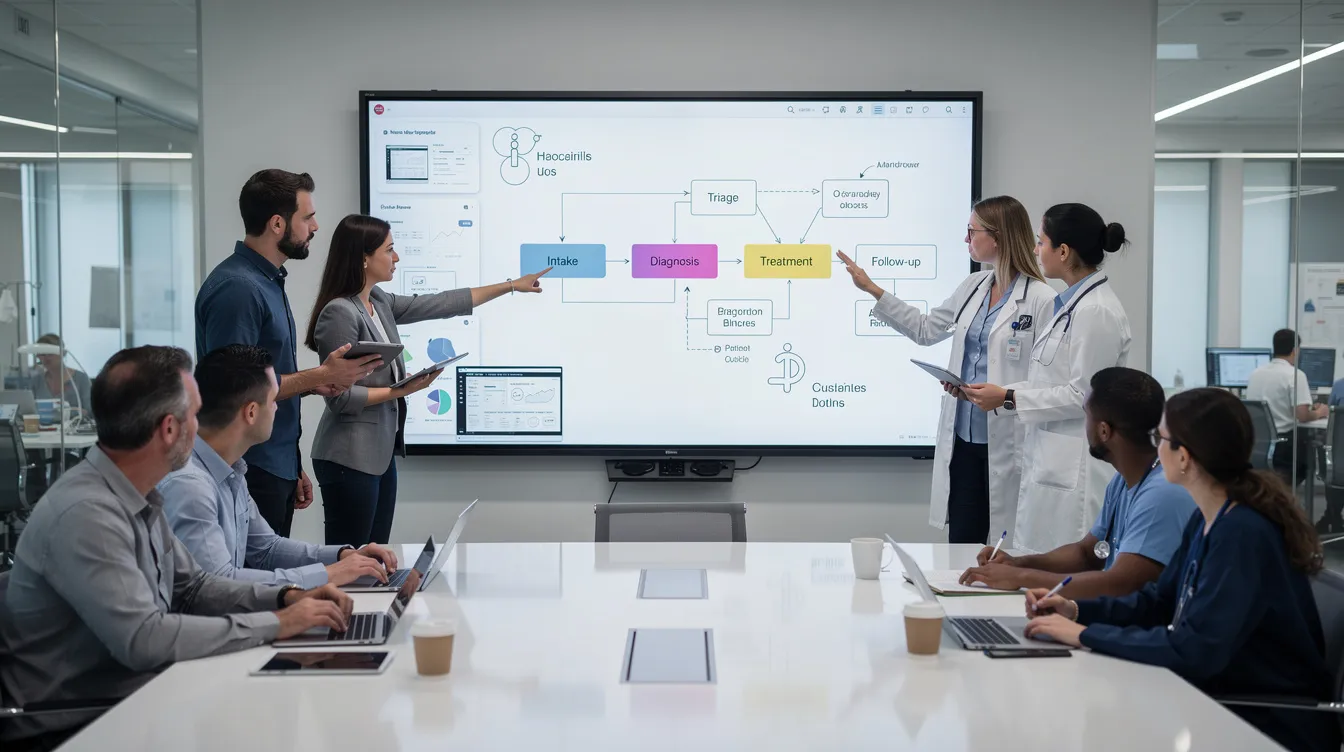
Quick Comparison of the Best Hospital Management System Approaches
Here is a scannable snapshot mapping each approach to its ideal context. HMS streamlines workflows leading to quicker diagnoses and improved outcomes regardless of approach – the question is which model fits your constraints.
- Fully Integrated Enterprise Platform – Best for high-volume tertiary hospitals seeking unified control and standardized workflows across all departments.
- Modular Best-of-Breed Stack – Best for organizations wanting maximum flexibility and top-tier tools per department with gradual modernization.
- Cloud-Native HMS (SaaS-First) – Best for small and mid-sized healthcare facilities needing quick deployment, low upfront costs, and minimal infrastructure headaches.
- Hybrid HMS (On-Prem + Cloud) – Best for hospitals with strict data residency rules but ambitions for digital front-door services and modern patient engagement.
- Custom-Built HMS Platform – Best for providers treating digital infrastructure as a strategic differentiator and seeking AI-ready architecture with complete control.
How to Choose the Right Hospital Management System
The right hospital management system depends on facility size, country, legacy systems, clinical complexity, and digital maturity. There is no universal answer, and anyone who tells you otherwise is selling something that will not survive contact with your actual workflows. This section maps the decision factors.
Choose Based on Facility Size and Service Scope
Outpatient clinics with ten to fifty providers typically need streamlined scheduling, billing, and electronic health records – a cloud-native SaaS system handles this well. General hospitals with an emergency department, ICU, and multiple operating rooms need deeper integration across departments. Tertiary care centers and academic medical centers with complex treatment plan requirements, research data, and high patient volumes are better served by fully integrated enterprise platforms or custom builds. HMS enhances patient experience by reducing wait times and personalizing care, but the complexity of achieving that scales with facility size.
Choose Based on Regulatory and Data Residency Requirements
National health data laws can dictate whether you host on-premise, in a local cloud region, or in a hybrid configuration. International hospital groups face cross-border data transfer restrictions that complicate centralized cloud architectures. Healthcare regulations vary significantly – what works in the U.S. under HIPAA may not satisfy EU requirements under GDPR or local laws in the Middle East or Southeast Asia.
Choose Based on Existing IT Landscape and Integration Needs
Hospitals running legacy hospital database management system infrastructure, standalone laboratory information systems, or national EHR connections should factor integration costs heavily into the decision. If your current systems do not support APIs, budget for middleware or replacement. Using interoperability standards – HL7 v2, FHIR, DICOM – as a core selection criterion prevents expensive surprises. Medical history, immunization records, x rays, lab results, and test results all need to flow between systems without manual re-entry.
Choose Based on Budget, Timeline, and Internal Capacity
Capital budget, acceptable ROI horizon (three years versus seven years), and availability of internal IT staff all shape the decision. If you need to be live in under six months with minimal administrative work, a SaaS platform is realistic. If you can invest in a twelve-to-eighteen-month hospital management system project with phased rollout, custom or enterprise options deliver deeper long-term value. A multi-clinic network consolidated six disconnected systems into one platform in 14 weeks, reducing administrative overhead by roughly one-third and cutting billing reconciliation from a week to half a day. Timeline is achievable – but it requires clear scope and informed choices upfront.
Which Hospital Management System Approach Is Best for You?
Every approach above works. The question is which one works for your specific constraints. Here are direct recommendations:
- Choose Fully Integrated Enterprise Platform if you manage a high-volume, multi-department hospital and can invest in a multi-year rollout with significant change management.
- Choose Modular Best-of-Breed Stack if you already have strong departmental systems and want to modernize through integration and selective replacements without disrupting what works.
- Choose Cloud-Native HMS if you run a smaller facility and need fast go-live, predictable monthly costs, and minimal infrastructure overhead. Quick access to modern tools matters more than deep customization.
- Choose Hybrid HMS if healthcare regulations require local storage but you want modern patient portals, telehealth, and analytics capabilities.
- Choose Custom-Built HMS with WTT Solutions if you need unique workflows, tight AI integration, and a strategic digital platform tailored to your network – one where physicians, nurses, and staff based roles each get exactly the interface they need.
How WTT Solutions Supports Hospital Management System Projects
WTT Solutions is a healthcare-focused custom software development partner, not a boxed HMS vendor. We design, build, and integrate hospital management software components: web portals, mobile apps, admin panels, analytics dashboards, and AI modules. The one biggest advantages of working with a development partner rather than buying a product is that the system fits your hospital – not the other way around.
Domain-Aware Discovery and Architecture
Every hospital management system project starts with discovery: mapping current workflows, compliance constraints, and integration points with existing EHR, LIS, and RIS systems. We interview clinicians, administrators, and compliance officers before writing code. The output is an architecture blueprint using technologies like .NET, Node.js, React, Angular, Vue, Flutter, and React Native – selected based on what the project needs, not what is trendy. Efficient management of medical equipment, patient data, and medical records requires architecture decisions made with clinical context, not just engineering preferences.
Custom Development and Integration
We build custom modules – scheduling, billing, bed management, inventory, patient portals – and connect them to existing healthcare systems using HL7, FHIR, and DICOM standards. Whether the hospital needs a web application for administrative staff or a mobile app for bedside documentation, each component is built for the specific users: doctors, nurses, physicians, and administrative teams handling different tasks. Customer experience for patients – from appointment booking through discharge – is designed as a continuous flow, not a series of disconnected screens.
AI, Analytics, and Continuous Improvement
WTT Solutions adds predictive analytics, generative AI assistants for staff, and automated reporting on top of HMS data. Automated reporting aids informed decision-making in healthcare by surfacing patterns that manual review would miss. Data analysis across hospital operations turns raw numbers into actionable operational efficiency improvements. We provide ongoing support with SLA-backed response times and co-create the product roadmap with hospital leadership, because a hospital management system is not a project that ends at launch.
Final Thoughts on Modern Hospital Management Systems
The best hospital management system is the one that matches your clinical complexity, regulatory environment, and long-term digital strategy – not the one with the longest feature list. Hospitals should avoid purely feature-checklist decisions and instead prioritize interoperability, usability, and scalability. Quality care depends on systems that support medical professionals rather than burden them, and that means choosing architecture and partners that understand how healthcare actually works on the ground.
Every facility – from a 50-bed community hospital to a multi-site tertiary network – faces the same core challenge: unifying patient care, hospital operations, and financial management into a system that staff will actually use. The benefits of hospital management technology are real and measurable, but they require honest assessment of where you are today and where you need to be.
If you are planning a hospital management system project or modernizing an existing platform, WTT Solutions can help you map the path from current state to a system that fits. Tell us what you are running today and what is breaking. We will tell you what is realistic.
Leave a Reply